

Industrial Precision Cleaning Solutions

Best Technology supplies industrial vapor degreasing equipment for manufacturers requiring reliable, repeatable precision cleaning. Our vapor degreasers are configured around each customer’s application, including part dimensions, contaminants, cleaning requirements, solvent selection, and production throughput.
We offer equipment solutions ranging from compact benchtop vapor degreasers to floor-standing production systems with optional ultrasonic cleaning and automation.
By combining our equipment expertise with our BestSolv® Engineered Fluids, we help manufacturers select both the cleaning system and the solvent chemistry needed for their specific process.
Industrial Vapor Degreasing Equipment Options
Choosing a vapor degreaser involves more than matching the equipment dimensions to the parts being cleaned. The machine must also support the required solvent, cleaning cycle, production volume, and recovery process.
Best Technology offers three primary vapor degreasing configurations, each providing different cleaning capabilities depending on the application.

Immersion Vapor Degreasers
Immersion vapor degreasers include a liquid solvent sump where parts can be submerged for cleaning before being processed in the vapor zone.
This configuration allows manufactured components to undergo liquid solvent cleaning in addition to vapor cleaning and drying.
It can be considered for applications requiring immersion to remove oils, grease, and other soluble contaminants.
Ultrasonic Immersion Vapor Degreasers
Ultrasonic immersion vapor degreasers use a similar configuration but include ultrasonic cleaning in the liquid immersion sump.
The ultrasonic action provides additional cleaning capability by generating cavitation in the solvent, helping dislodge contamination from complex geometries and difficult-to-reach surfaces.
This configuration can be considered when immersion and vapor cleaning alone are not sufficient for the required cleanliness.
Vapor-Only Degreasers
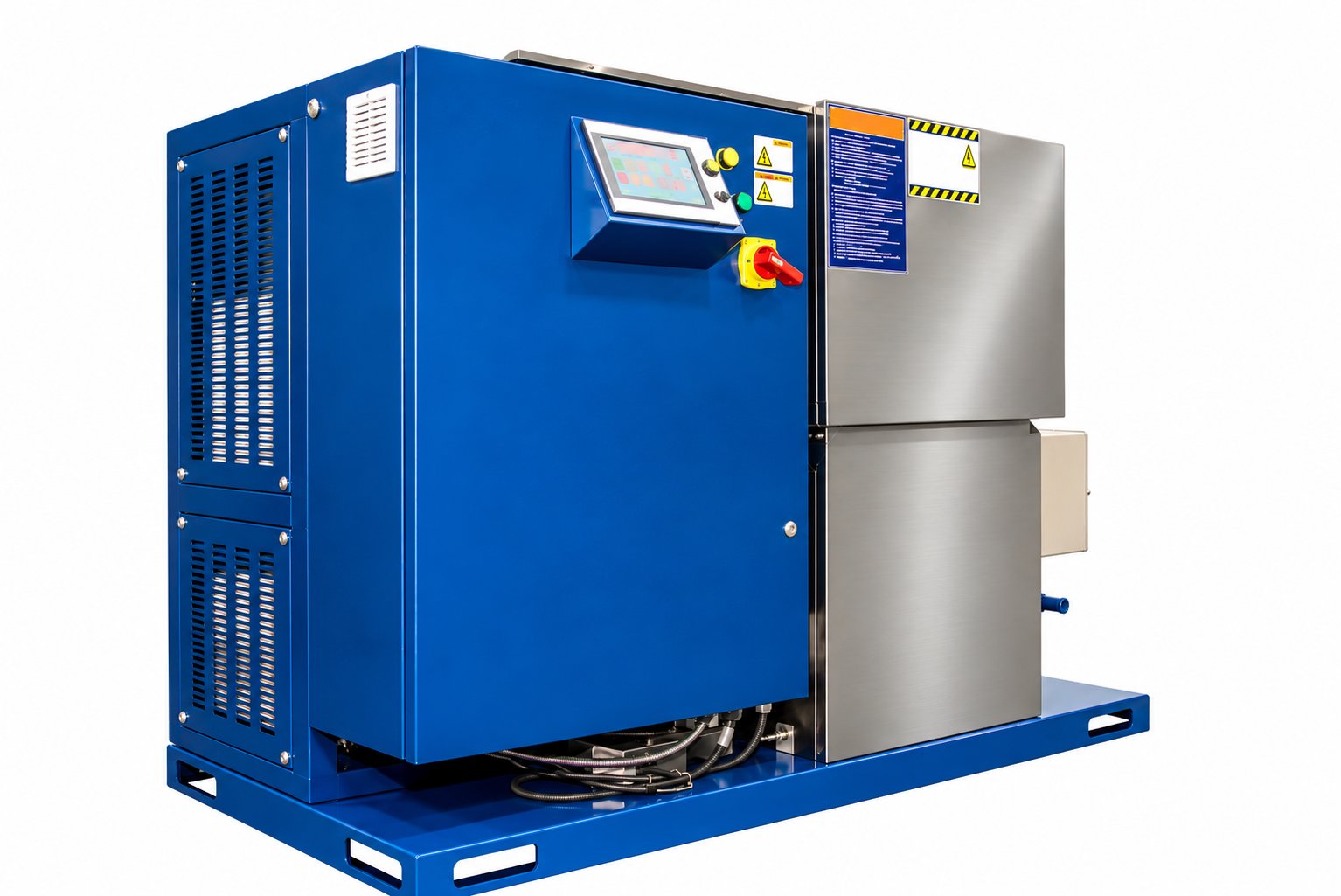
Vapor-only degreasers clean components in the solvent vapor zone without a separate, accessible liquid immersion sump.
Parts are exposed to solvent vapor, which condenses on cooler surfaces and dissolves soluble contamination before evaporating.
Because these machines do not incorporate an accessible immersion cleaning stage, they generally have a simpler configuration and can be more economical than immersion-based alternatives.
Equipment Sizes and Configurations
Best Technology offers configurations available to accommodate different cleaning and production requirements.
Equipment selection depends on factors such as part dimensions, load capacity, solvent properties, required cleanliness, and available utilities.
Systems may be configured for immersion cleaning, ultrasonic-assisted immersion cleaning, or vapor-only cleaning.
Rather than selecting equipment solely by model number, Best Technology helps manufacturers evaluate the cleaning requirements and identify an appropriate configuration.
Vapor Degreasing Equipment Configurations and Automation
A properly designed vapor degreaser must account for how parts enter the system, move through the cleaning stages, and exit ready for subsequent operations.
Depending on the application and available equipment options, vapor degreasing systems may incorporate:
- Single- or multiple-sump configurations
- Ultrasonic cleaning stages
- Automated part handling and hoist systems
- Refrigerated cooling and vapor containment features
- Solvent distillation and recovery
- Solvent monitoring and process controls
Best Technology works with manufacturers to evaluate these requirements and develop equipment solutions appropriate for their processes.
Video: Automated Ultrasonic Vapor Degreasing

Vapor Degreaser Solvent Recovery and Operating Efficiency
Solvent recovery is an important consideration in modern vapor degreasing equipment, particularly when using specialized engineered cleaning fluids.
Vapor degreasers incorporate cooling and condensation systems that help capture solvent vapor and return condensed liquid to the cleaning process.
Proper system sizing and operating controls can help reduce solvent loss, limit unnecessary consumption, and support stable cleaning performance.
Important equipment considerations include freeboard height, refrigeration capacity, vapor containment, distillation performance, and part loading practices.
Manufacturers should also account for equipment location and nearby airflow, since drafts and ventilation conditions can affect solvent retention.
Learn more about minimizing solvent loss in vapor degreasing equipment.
Common Applications for Vapor Degreasing Equipment
Best Technology supplies vapor degreasing equipment for industrial applications requiring precision cleaning and repeatable processing.
Medical Device Manufacturing
Equipment may be configured for cleaning medical instruments and precision manufactured components before further processing, inspection, or assembly.
Aerospace Manufacturing
Vapor degreasing systems can be used for cleaning machined metal components and assemblies where controlled contamination removal is important.
Electronics and Semiconductor Manufacturing
Compatible cleaning systems can support removal of selected flux residues, machining oils, and other manufacturing contaminants.
Precision Machining and Metal Finishing
Vapor degreasers can remove machining oils and lubricants from manufactured components before downstream finishing or assembly operations.
The appropriate system configuration depends on the parts, contaminants, cleanliness requirements, and production volume.
Vapor Degreasing Equipment Specifications
Equipment specifications should be evaluated according to the actual vapor degreaser configuration being considered.
Important considerations include:
- Usable cleaning chamber dimensions
- Overall equipment dimensions and available floor space
- Solvent capacity
- Cleaning and rinse stages
- Ultrasonic cleaning capabilities, where applicable
- Electrical and utility requirements
- Heating and cooling requirements
- Automation and part handling options
Best Technology can help manufacturers evaluate these specifications to identify equipment appropriate for their cleaning process and production needs.
Selecting the Right Vapor Degreasing System
Every precision cleaning application presents a different combination of technical requirements.
When evaluating equipment, the most important factors typically include:
- Part size and geometry: Determines usable cleaning dimensions and handling requirements.
- Type of contamination: Influences solvent selection and additional cleaning stages.
- Production throughput: Helps establish cycle times and equipment capacity.
- Cleanliness requirements: Determines the process and validation needs.
- Solvent properties: Influences temperature, cooling, and recovery requirements.
- Available floor space and utilities: Affects installation and equipment configuration.
- Automation requirements: Determines part handling and process control needs.
A complete understanding of these factors allows the cleaning process to be designed around production requirements rather than requiring manufacturers to adapt their processes to unsuitable equipment.
BestSolv® Engineered Fluids for Vapor Degreasing Equipment
Selecting the right vapor degreasing equipment also means selecting the appropriate cleaning solvent.
Best Technology offers BestSolv® Engineered Fluids for precision cleaning applications, giving manufacturers access to equipment and chemistry expertise through one supplier.
The solvent influences several aspects of equipment operation, including operating temperatures, vapor generation, cooling requirements, cleaning effectiveness, and material compatibility.
BestSolv® Engineered Fluids provide cleaning solutions for applications involving machining oils, greases, lubricants, flux residues, and other manufacturing contaminants. Available formulations offer different solvency characteristics, boiling points, and environmental profiles, allowing manufacturers to select a fluid based on their equipment compatibility, cleaning requirements, and operational priorities.
For manufacturers specifically for an alternative to discontinued 3M™ Novec™ engineered fluids, BestSolv® offers multiple solvent pathways, including:
Exact-molecule replacements for discontinued 3M™ Novec™ fluids: Options for manufacturers seeking to maintain continuity with previously used solvent chemistries.
Similar-molecule alternatives: Engineered cleaning fluids that offer comparable properties for applications where an alternative formulation is appropriate.
PFAS-free cleaning solvents: Options for manufacturers evaluating different solvent chemistries as part of their cleaning and regulatory requirements.
Solvent selection must also account for the types of contamination being removed. Oils, greases, machining lubricants, and flux residues can require different solvency characteristics.
Our technical team can help evaluate the solvent, equipment, and cleaning requirements together to identify a suitable process.
Learn more about choosing a vapor degreaser solvent.
Related Vapor Degreasing Resources
What Is Vapor Degreasing?
Learn how the vapor degreasing process works, its advantages, common applications, and factors affecting cleaning performance.
Featured Vapor Degreasing Case Study

Medical Device Vapor Degreaser
See an example of a vapor degreasing system for medical device instruments.
Bi-Solvent and Co-Solvent Vapor Degreasing
Explore additional equipment and cleaning process options for applications involving difficult-to-remove oils, greases, waxes, and flux residues with Bi-Solvent and Co-Solvent Vapor Degreasing.
Solvent Cleaning FAQs
- Why use cleaning solvents?
- What are PFAS chemicals?
- 3M™ Novec™ phase out
- nPB phase out
- TCE phase out
- Methylene chloride phase out
- What is an azeotrope?
- What is kauri-butanol value?
- How to choose a vapor degreaser solvent
Why Work With Best Technology?
Best Technology helps manufacturers evaluate industrial cleaning systems based on the requirements of their parts and manufacturing processes.
Our approach combines equipment application knowledge, cleaning process considerations, and access to engineered cleaning fluids.
This allows customers to evaluate not only the vapor degreaser itself, but also how the equipment and solvent work together to achieve the required cleaning results.
Whether the goal is implementing a new cleaning process, increasing capacity, or evaluating alternative solvents, our team can help identify the appropriate next steps.
Request a Vapor Degreasing Equipment Proposal
Looking for a vapor degreaser that fits your parts, cleaning requirements, and production needs?
Contact Best Technology to discuss your application. Our equipment specialists can help evaluate the system requirements and recommend an appropriate vapor degreasing solution.

 612.392.2414


