

- System Description
- Salt Fog vs. Humidity Testing: Understanding the Difference
- Key Features & Benefits
- Common Applications
- Industry Standards
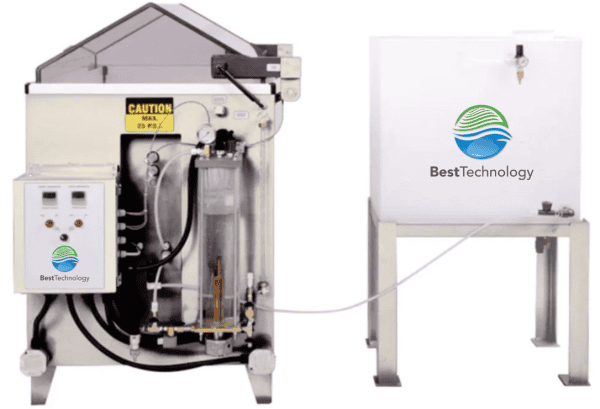
Salt Fog and Humidity Test Chamber System Description
Best Technology’s Salt Fog Chamber and Humidity Test Chamber provide a controlled corrosion chamber environment for testing the corrosion resistance, durability, and long-term material performance of metal components, coatings, and finishes.
Salt fog and humidity test chambers simulate harsh environmental conditions to test material and process reliability. These corrosion chambers can replicate marine environments with salt fog, high humidity conditions, and even the salinity of the human body to test medical implants. This ensures that your products meet the highest industry standards, even under prolonged exposure to extreme conditions.
Designed for precision and repeatability, these test corrosion chambers are fully compliant with industry specifications, including ASTM B117, AMS 2700, MIL-DTL-5541, and ISO 9227, making them ideal for passivation verification tests and chem film validation for aerospace coatings and medical device testing.
More than just meeting specifications, these test chambers help manufacturers reduce risk, speed up validation, and lower costs associated with product failures. By ensuring that parts meet corrosion standards before they reach the field, companies can avoid expensive rework, warranty claims, or delayed certifications. Whether you’re launching a new medical device or qualifying aerospace coatings, this corrosion chamber testing system delivers a faster path to market approval and long-term savings through improved product reliability.
Why Corrosion Testing is Critical

Corrosion is a major concern across multiple industries where materials are exposed to harsh environments. Over time, oxidation, pitting, and surface degradation can compromise the structural integrity of critical components. By using a Salt Fog Chamber or Humidity Test Chamber, manufacturers can:
- Validate corrosion-resistant coatings: Ensure materials coated with chem film (chromate conversion coating) or anodizing withstand corrosive conditions.
- Confirm passivation effectiveness: Test passivated stainless steel for free iron contamination.
- Ensure regulatory compliance: Meet and exceed strict standards in aerospace, medical, and automotive industries.
- Prevent costly failures: Identify material weaknesses before components are deployed in the field.
A corrosion chamber allows manufacturers to replicate real-world conditions in a controlled environment, making it possible to evaluate coatings, finishes, and materials with precision. By exposing parts to accelerated salt spray or humidity cycles, a corrosion chamber provides reliable data that helps engineers predict long-term performance.
For industries where failure is not an option, a corrosion chamber is an indispensable tool for quality assurance and product validation. From aerospace components to medical devices, using a corrosion chamber ensures that materials and protective treatments meet the highest durability standards before reaching the field.
Ultimately, these chambers go beyond simulating harsh environments, they help safeguard your bottom line. Identifying corrosion risks early prevents costly field failures, protects brand reputation, and ensures products reach customers with proven durability. For regulated industries like medical, aerospace, and defense, where test failures can stall programs or trigger audits, this level of performance assurance translates directly into reduced risk and higher profitability.
Salt Fog vs. Humidity Testing: Understanding the Difference
Both Salt Fog Chambers and Humidity Test Chambers simulate harsh environments to assess material durability, but they serve different testing needs. While both methods are primarily used for corrosion resistance testing, they differ in how they create corrosive conditions. Salt Fog Chambers expose samples to a fine saline mist in a high-humidity environment, combining salt spray with 94–100% relative humidity to accelerate corrosion. In contrast, Humidity Test Chambers evaluate moisture tolerance using deionized water and controlled humidity and temperature—without salt—making them ideal for assessing how materials hold up to prolonged moisture exposure.
Salt Fog Chamber Testing (ASTM B117 salt spray test chamber, MIL-STD 810 Salt Fog Test)
- Purpose: Evaluate the corrosion resistance of materials exposed to a fine mist of saltwater.
- Uses: Testing passivation effectiveness, verifying chem film coatings, and evaluating metals for marine, aerospace, and medical device applications.
- Test Environment:
- 94-100% relative humidity (RH)
- Saltwater mist dispersed via a fog tower
- Controlled pH (typically 6.5-7.2)
- Collection rate requirement: 1-2 mL per hour to meet ASTM B117 standards
Humidity Test Chamber (ASTM D2247, MIL-STD-810, ISO 9227, Environmental Chamber Testing)
- Purpose: Assess how materials withstand long-term exposure to high humidity levels.
- Uses: Testing coatings, adhesives, electronic enclosures, and medical instruments.
- Test Environment:
- 97% ± 3% humidity (94-100% RH)
- No salt spray—uses deionized (DI) water
- Longer duration (typically 24+ hours)
Can One Chamber Perform Both Tests?
Yes! Best Technology offers a multipurpose chamber capable of performing both Salt Spray and Humidity tests within the same unit, providing cost-effective, space-saving versatility. Operators can easily switch between test modes by adjusting water supply settings and chamber controls. These chambers are engineered with flexibility and functionality in mind, delivering maximum value for real-world applications through adaptable performance and real-time feedback of critical testing parameters, ensuring consistent and reliable results in the field.
The ability to perform both salt spray and humidity testing in a single chamber doesn’t just save space, it optimizes operational efficiency. With fewer equipment changeovers and faster test setup, teams can accelerate product validation timelines and reduce overall testing costs. That speed-to-market advantage can give your business a competitive edge, especially in industries where every week of delay affects revenue, market share, or contract approvals.
Test Chamber Features
By combining advanced features with purposeful design, Best Technology’s Salt Fog and Humidity Test Chambers aren’t just about compliance, they deliver measurable value. Automated water and salt solution systems reduce labor costs and operator error, while real-time data tracking minimizes downtime and rework. The result? Faster testing cycles, fewer product failures in the field, and significant cost savings on warranty claims or recalls. This isn’t just equipment, it’s an investment in productivity, reliability, and long-term quality.
Key Features & Benefits
Our Salt Spray and Humidity Test Chambers incorporate industry-leading technology to ensure reliable, accurate, and repeatable test results.
Multiple Chamber Sizes & Configurations
| Model | Internal Volume (ft³) | Exposure Zone (W × D × H, in) |
| BT15 | 15 ft³ | 22 × 30 × 39 |
| BT21 | 20 ft³ | 29 × 30 × 39 |
| BT22 | 30 ft³ | 45 × 30 × 39 |
| BT23 | 68 ft³ | 72 × 42 × 39 |
| BT24 | 100 ft³ | 93 × 48 × 39 |
| BT410 | 130 ft³ | 120 × 48 × 39 |
| BT512 | 180 ft³ | 144 × 48 × 39 |
- Low-profile, standard, and high-profile models for different part sizes.
Automated Water & Salt Solution Management
- ATO-Fill System: Automatically maintains water and salt solution levels, reducing operator workload.
- Integrated Mixing Tank: Provides consistent test conditions for ASTM B117 compliance.
Advanced Humidity & Fog Distribution
- Horizontal & Vertical Fog Towers: Ensures even mist dispersion and full sample coverage.
- Adjustable Airflow & Temperature Controls: Enables precise simulation of real-world environmental conditions.
Data Recording & Process Control
- Microprocessor-Based Controllers: Programmable for ASTM B117 and other specifications.
- Real-Time Monitoring: Integrated sensors track humidity, temperature, and collection rates.
Century Series Spray Chamber

High Pressure Spray System

- Simulates a High Pressure wash test
- Four individual high pressure spray nozzles can be activated in series
- Quick disconnects make change out fast and easy
- Pressures from 400 to 1400 psi
- Adjustable nozzle positioning
Common Applications for Salt Fog & Humidity Test Chambers
Medical Device & Implant Testing
- Salt Spray Test Chamber: Ensures 316 stainless steel medical implants resist corrosion before implantation.
- Humidity Test Chamber: Verifies that surgical instruments maintain integrity after sterilization.
Aerospace & Military Compliance
- AMS 2700 & MIL-DTL-5541 testing for chem film-coated aluminum.
- Simulates atmospheric corrosion to assess metal degradation.
Automotive & Industrial Coating Durability
- Ensures paints, platings, and coatings resist corrosion in extreme climates.
- Verifies the performance of powder-coated and anodized surfaces.
Electronics & Semiconductor Reliability Testing
- Prevents circuit board failure caused by moisture-induced corrosion.
- Ensures that seals, adhesives, and enclosures withstand prolonged humidity exposure.
Common Industry Standards
| Standard | Title / Description |
| ASTM B117 | Standard Practice for Operating Salt Spray (Fog) Apparatus. The most widely used salt fog corrosion test method for evaluating coatings and materials. |
| MIL-STD-810 | U.S. military standard defining environmental test conditions, including salt fog exposure for aerospace and defense applications. |
| ISO 9227 | International standard specifying salt spray test methods for corrosion testing of metallic coatings. |
| ASTM G85 | Modified Salt Spray (Fog) Testing, which includes cyclic corrosion testing to simulate real-world environments. |
| DIN 50021 | (Superseded) The standard DIN 50021:1988-06 has been withdrawn and replaced by DIN EN ISO 9227. |
Humidity Testing Standards
| Standard | Title / Description |
| ASTM D2247 | Standard Practice for Testing Water Resistance of Coatings in 100% Relative Humidity. |
| ISO 6270-2 | Paints and varnishes—Determination of resistance to humidity—Part 2: Condensation (In-Cabinet Exposure). |
| MIL-STD-202G | Test Method Standard for Electronic and Electrical Components: Humidity resistance testing. |
| IEC 60068-2-78 | Environmental testing—Part 2-78: Tests—Test Cab: Damp heat, steady state. |
Why Choose Best Technology?
At Best Technology, we provide turnkey solutions for corrosion prevention and environmental testing. By integrating Salt Fog Chamber and Humidity Test Chamber systems with our passivation and chem film solutions, we offer a one-stop solution for manufacturers needing full process validation.
Ready to Enhance Your Testing Capabilities?
Ensure your passivation, chem film coatings, and corrosion-resistant materials meet industry standards with Best Technology’s Salt Fog Chamber and Humidity Test Chamber systems.
Contact us today to discuss your testing needs and find the right Salt Spray Test Chamber or Humidity Test Chamber for your application.
📞 Get expert guidance on the best testing solution for your needs! Call us today to find the ideal Salt Spray Test Chamber or Humidity Test Chamber for your application and ensure your materials stand up to the toughest conditions.

 612.392.2414


