

Below are some frequently asked questions about our automated cleaning and passivation systems.
-
Why are automated systems easier to process validate than manual equipment?
Process control and stability are critical aspects to regulated medical device and aerospace processes. It is important to ensure that a process has input and output variable limits which are defined and fully tested during process design, Equipment Qualification (IQ), Operational Qualification (OQ) and Process Qualification (PQ) validation testing. Setting up a proper DOE (Design of experiments) to test these limits is also important as the results of the DOE will give statistical confidence intervals of the limits.
Being that operators and employees perform various process operations different no matter how instructed in work instructions, the variation of operators must also be captured during process qualification (PQ) validation. An automated system typically eliminates many of the operator variability in the manufacturing process and this process “input” elimination also allows for tighter process output controls.
For example, in our automated passivation system, the elimination of relying on an operator to move the parts basket from stage to stage ensures that the parts remain in the appropriate (wash, rinse, acid passivation, etc) solutions for the process defined times and in accordance with the proper ASTM A967, AMS2700, etc specification. If a parts basket is immersed in the acid passivation solution too short or long duration, the passivation can likely fail and be outside specification limits.
-
Do you need any agitation beyond ultrasonics during the cleaning or passivation process with an automated system?
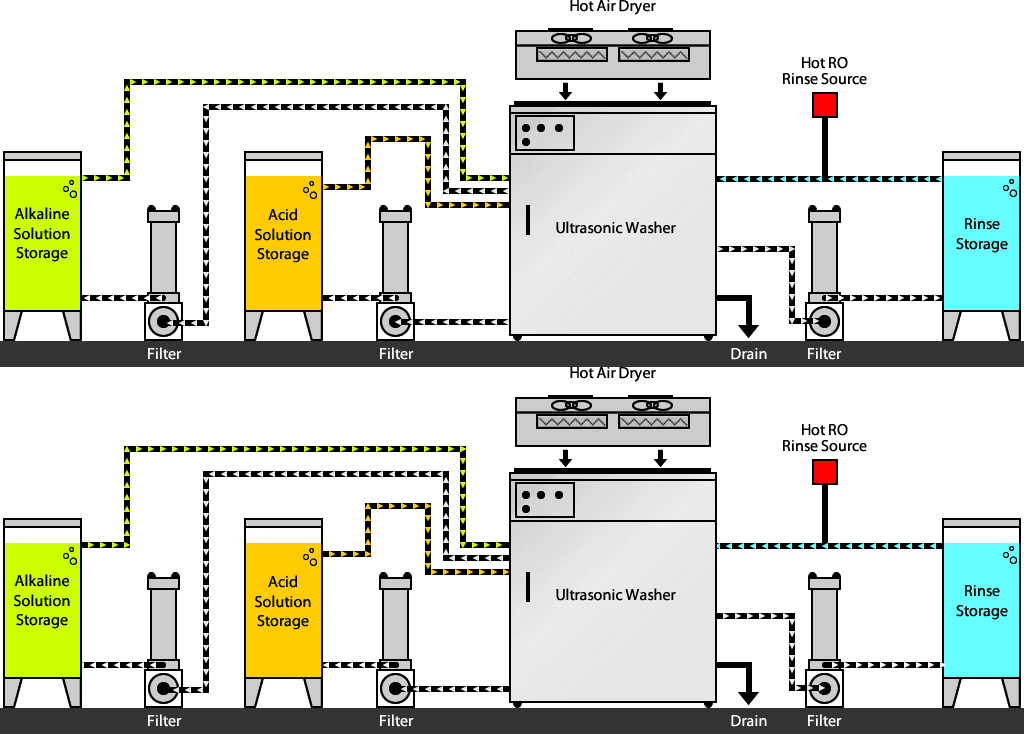
Our automated cleaning and passivation system includes in-process tank circulation which agitates the solution, alternating between ultrasonics (as fluid movement dissipates ultrasonic energy). This also allows the process tank to filter solution back in the storage tank.
-
In an automated system, are there contamination issues when you pump solutions out of the main processing tank?
Many of our automated cleaning and passivation systems pump the cleaning, rinsing and passivation acid solutions between tanks, unlike a traditional system where the parts are moved from tank to tank.
To reduce any contamination issues, we mount rinse spray nozzles in the cover of the system to rinse down the parts and tank walls. All the plumbing to and from the process tanks is separated to further reduce any contamination. This results in less contamination compared to the drag-out that occurs from moving parts from tank-to-tank in a traditional multi-tank setup.
-
What is the industry standard for acceptable particle count after cleaning or passivation?
Acceptable particle counts depend on the specification which the parts are processed to: ASTM A967, A380, F86, AMS 2700, etc. For passivation, DI rinse water is recommended for best results.
Our automated systems offer conductivity meters which monitor water quality and total dissolved solids. The storage tanks have facility DI water source needle valves which open when conductivity limits are not met. This allows for a continual overflow of the rinse tank until rinse water specifications are reached.
-
What are the pros and cons of ultrasonic automated systems vs. rail-mounted gantry crane automation?
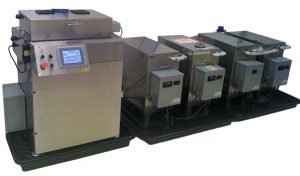
Ultrasonic Automated System
Moves the fluids, not the parts.
 Pros:
-
Lower System Cost: Typically less expensive to purchase and install.
-
Simplified Maintenance: Fewer moving parts reduce the risk of mechanical failure and simplify upkeep.
-
Compact Footprint: Takes up less space on the production floor.
-
Flexible Tank Placement: Storage tanks can be located outside of the cleanroom or processing area.
-
Closed-Loop Operation: Minimizes operator exposure to chemicals, improving safety and compliance.
Cons:
-
Longer Cycle Times: Requires time to fill and drain the process chamber (typically ~2 minutes each).
-
Single-Basket Workflow: You must wait for the entire cycle to finish before processing the next batch.
-
Process Limitations: Not compatible with pickling or descaling applications.
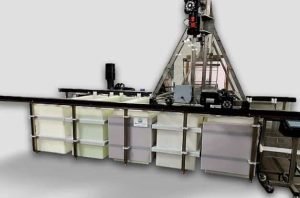
Rail-Mounted Gantry Crane Automation
Baskets of parts are moved automatically through a series of tanks.
 Pros:
-
Higher Throughput: Multiple baskets can be processed in succession, increasing production capacity.
-
Scalable Design: Systems can be built much larger to handle high-volume needs.
-
Supports Pickling/Descaling: Capable of handling aggressive chemical processes.
-
Faster Cycles: No fill or drain steps—parts move through already-filled process tanks.
Cons:
-
Higher Initial Cost: Requires more infrastructure and automation.
-
Larger Footprint: Occupies more floor space compared to pump-based systems.
-
Increased Maintenance: More mechanical components introduce additional maintenance needs.
-

 612.392.2414


