Best Technology

Precision Cleaning, Passivation & Finishing Systems

Call Us612.392.2414
Contact an Expert
  • Equipment
    • Industrial Parts Washers
    • Ultrasonic Cleaning Systems
    • Vapor Degreasing Systems
    • Passivation Equipment
    • Electropolishing Equipment
    • Chem Film Equipment
    • Titanium Anodizing Systems
    • Mass Finishing Machines
    • Automation Systems
    • Wet Benches
    • Specialty & Custom Industrial Process Systems
  • Chemicals
    • Chemicals, Solvents & Fluids
    • BestSolv® Engineered Fluids
    • 3Mâ„¢ Novecâ„¢ Replacement Fluids
    • 3Mâ„¢ Novecâ„¢ Engineered Fluids, Chemicals, & Solvents
    • 3Mâ„¢ Novecâ„¢ HFE Engineered Fluids and PFAS Phase Out
  • Industries
  • Articles
    • FAQ – Frequently Asked Questions
    • Ultrasonic Cleaning
      • How Do Ultrasonic Cleaners Work?
    • Passivation
      • What is Passivation?
    • Electropolishing
      • What is Electropolishing?
    • Surface Finishing
      • What is Alodine® / Chem Film / Chromate Conversion Coating?
      • What is Titanium Anodizing?
    • Industrial Parts Washers
    • Automation Systems
  • Case Studies
    • Industry Applications
    • Industrial Parts Washer Case Studies
    • Passivation Systems Case Studies
    • Part Cleaning Case Studies
    • Part Finishing Equipment Case Studies
    • Ultrasonic Cleaning Systems Case Studies
  • Testimonials
  • About Us
  • Contact Us
  • Equipment
    • Industrial Parts Washers
      • Products
        • Agitated Immersion Heated Parts Washer
        • Automatic Parts Washer System with Conveyor
        • Phosphating Lines
        • Automated Phosphate Lines for High-Volume Powder Coat Pre-Treatment
        • Oil Removal Systems
      • Case Studies
        • Pipe Washing Equipment
        • Designing a Phosphate Line for Today’s Process and Tomorrow’s Needs
        • Machine Shop Parts Washer for True Oil
        • Automotive Parts Washer System
    • Ultrasonic Cleaning Systems
      • Product Information
        • How Clean is Clean?
        • How Do Ultrasonic Cleaners Work?
        • What is an Azeotrope?
      • Products
        • Benchtop Ultrasonic Cleaner
        • Benchtop Ultrasonic Parts Cleaning Multi-Tank Systems
        • Ultrasonic Cleaning Consoles
        • Automated Ultrasonic Parts Cleaning Equipment Wash-Rinse-Dry
        • Automated Ultrasonic Cleaning System for High-Volume Production
        • Large Ultrasonic Parts Cleaner with Agitated Immersion
        • Immersible Ultrasonic Transducers
      • Case Studies
        • Automated Pickling and Cleaning System Case Study
        • Automated Ultrasonic Injection Mold Cleaner System
        • 3D Printer / FDM Parts Post Process Ultrasonic Cleaning
        • Machine Shop Parts Washer for Swiss and CNC Precision Parts
    • Vapor Degreasing Systems
      • Product Information
        • What Is Vapor Degreasing?
      • Products
        • Vapor Degreasing Systems
        • Vapor Degreasing Equipment and Ultrasonic Vapor Degreasers
      • Case Studies
        • Vapor Degreaser For Medical Device Instruments
    • Passivation Equipment
      • Product Information
        • What is Passivation? How Does It Work?
        • Nitric vs. Citric Acid Passivation
        • Passivation with Citric Acid
        • What Is Pickling of Stainless Steel? How Do Descaling, Pickling and Etching Work?
        • Passivation Cost Savings Calculator
      • Products
        • Benchtop Ultrasonic Passivation Equipment
        • Passivation Wet Bench for Citric / Nitric Acid
        • Ultrasonic Automated Passivation Equipment
        • Automated Passivation Systems for High-Volume Production
        • Agitated Immersion Multi-Tank Passivation Systems
        • Salt Fog and Humidity Test Chambers for Reliable Corrosion and Environmental Testing
      • Case Studies
        • Case Study: Bringing Citric Acid Passivation In-House for Stainless Steel Medical Device Parts
        • Automated Ultrasonic Passivation System for Medical Device Parts
        • Cleanroom Space Saving Automated Passivation System
        • Heated Polypropylene Acid Passivation and Rinse Tanks
        • Applicable Articles
    • Electropolishing Equipment
      • Product Information
        • What is Electropolishing? How Does Electropolishing Work?
        • Electropolishing Cycle and Current Calculator
        • Passivation vs. Electropolishing
      • Products
        • Tabletop Electropolishing Equipment & Electropolishing Machines
        • Electropolishing Wet Benches
        • Semi-Automated Electropolishing Systems for High-Volume Production
        • Large Scale Part Electropolishing Systems
      • Case Studies
        • EP System – Open Top Wet Bench with Spray Rinse
    • Surface Finishing Systems
      • Chem Film Equipment / Alodine Lines
        • Chem Film Equipment
        • What is Alodine / Chem Film / Chromate Conversion Coating?
        • Alodine Chem Film Tank Line
        • Ready to Set Up a Chem Film (Alodine) Line?
        • Automated Chem Film (Alodine) Systems
        • Hex Chrome Phase Out and Alternatives for Conversion Coating
        • Salt Fog and Humidity Test Chambers for Reliable Corrosion and Environmental Testing
      • Mass Finishing Machines
        • Centrifugal Barrel Finishing Machines
        • Vibratory Bowl Polishers
      • Titanium Anodizing
        • Titanium Anodizing Systems
        • What is Titanium Anodizing?
        • Titanium Anodizing Equipment
    • Automation Systems
      • Product Information
        • What Is Process Automation for Metal Finishing?
      • Products
        • Rail-Mounted Gantry Crane Automation
        • Automated Passivation Systems for High-Volume Production
        • Automated Ultrasonic Cleaning System for High-Volume Production
        • Automated Chem Film (Alodine) Systems
        • Semi-Automated Electropolishing Systems for High-Volume Production
        • Automated Phosphate Lines for High-Volume Powder Coat Pre-Treatment
        • Ultrasonic Automated Passivation Equipment
      • Case Studies
        • Automated Pickling and Cleaning System Case Study
        • Automated Passivation for High-Volume Production: Case Study
    • Wet Benches
      • Product Information
        • What is a Fume Hood? How Do Fume Hoods Work?
      • Products
        • Fume Hoods
        • Wet Bench for Semiconductor & FM4910 Applications
        • Wet Benches for Citric / Nitric Passivation of Stainless Steel and Titanium
        • Wet Benches for Electropolishing
        • Cascade Overflow Rinse Tanks
        • Quick Dump Rinse Tank
      • Case Studies
        • Semiconductor Chemical Processing Wet Bench and Fume Hood
    • Specialty & Custom Industrial Process Systems
      • Automated Chemical Neutralization Tank Cart
      • Salt Fog and Humidity Test Chambers
      • Vapor and Dryfilm PTFE Coating Systems
      • Heated Hot Air Parts Dryer
      • Solvent Recovery Equipment
    • Process Validation Templates
    • Equipment Financing
  • Chemicals, Solvents & Fluids
    • Chemicals, Solvents & Fluids from Best Technology
    • BestSolv® Engineered Fluids
    • Solvent Cleaning Fluids
      • Solvent Cleaning with BestSolv® Engineered Fluids
      • BestSolv® Alpha
      • BestSolv® Bravo
      • BestSolv® Delta
      • BestSolv® Echo
      • BestSolv® Lima
      • BestSolv® Omega: PFAS Free
      • BestSolv® Omega Plus: PFAS-Free
      • BestSolv® Sierra
      • BestSolv® Theta
      • BestSolv® Zeta: PFAS-Free
      • BestSolv® 5408: Boeing Spec BAC 5408 Qualified Cleaning Solvent
      • BestSolv® 7100
      • BestSolv® 7200
      • BestSolv® 7300
      • BestSolv® 71DE
      • BestSolv® 72DA
      • BestSolv® 72DE
      • BestSolv® 73DE
      • BestSolv® nPB: TCE Replacement
      • Latent Fingerprint Processing with BestSolv® Engineered Fluids
      • What Are Hydrofluoroether (HFE) Fluids?
      • Film Cleaning with BestSolv® 7200
      • Oxygen System and Oxygen Gauge Cleaning Solutions
      • Engineered Fluids for Fluid Simulation and Aerospace Vibration Testing
      • Carrier Fluids for Precision Deposition, Wetting, and Material Transport
      • Choosing the Best Vapor Degreaser Solvent
    • Thermal Management / Heat Transfer Fluids
      • Thermal Management / Heat Transfer with BestSolv® Engineered Fluids
      • BestSolv® Zulu Immersion Cooling Fluid
      • BestSolv® Zulu MAG Magnesium Protection Fluid
      • BestSolv® Zulu FS Fire Suppression Fluid
      • BestSolv® 7100
      • BestSolv® 7200
      • BestSolv® 7300
      • BestSolv® 3283
      • BestSolv® 40
      • BestSolv® Fluids as Coolants for Specialized Machinery and Chiller Systems
      • Magnesium Cover Gas, Re-Engineered for Today
      • Gross Leak Testing for Hermetic Components and Critical Assemblies
    • PFAS-Free Next Generation
      • BestSolv® Omega: PFAS-Free
      • BestSolv® Omega Plus: PFAS-Free
      • BestSolv® Zeta: PFAS-Free
      • PFAS-Free Cleaning Solvents for Vapor Degreasing Applications
      • BestSolv® HFO / HCFO Solvents for Precision Cleaning
    • 3Mâ„¢ Novecâ„¢ Replacements
      • 3Mâ„¢ Novecâ„¢ Replacement Fluids
      • 3Mâ„¢ Novecâ„¢ 7100 Replacements
      • 3Mâ„¢ Novecâ„¢ 7200 Replacement
      • 3Mâ„¢ Novecâ„¢ 7300 Replacement
      • 3Mâ„¢ Novecâ„¢ 71DA Replacements
      • 3Mâ„¢ Novecâ„¢ 71DE Replacement Options
      • 3Mâ„¢ Novecâ„¢ 71IPA Replacements
      • 3Mâ„¢ Novecâ„¢ 72DA Replacements
      • 3Mâ„¢ Novecâ„¢ 72DE Replacements
      • 3Mâ„¢ Novecâ„¢ 73DE Replacement
      • Running Out of 3Mâ„¢ Novecâ„¢ Stock? How to Transition to Your BestSolv® Replacement Path
    • 3Mâ„¢ Novecâ„¢ Engineered Fluids and Fluorinertâ„¢ Liquids
      • 3Mâ„¢ Novecâ„¢ Engineered Fluids
      • 3Mâ„¢ Novecâ„¢ HFE Engineered Fluids and PFAS Phase Out
      • 3Mâ„¢ Novecâ„¢ Cleaning Solvents
        • Solvent Cleaning with 3Mâ„¢ Novecâ„¢ Engineered Fluids
        • 3Mâ„¢ Novecâ„¢ 7100
        • 3Mâ„¢ Novecâ„¢ 7200
        • 3Mâ„¢ Novecâ„¢ 7300
        • 3Mâ„¢ Novecâ„¢ 71DA
        • 3Mâ„¢ Novecâ„¢ 71DE
        • 3Mâ„¢ Novecâ„¢ 71IPA
        • 3Mâ„¢ Novecâ„¢ 72DA
        • 3Mâ„¢ Novecâ„¢ 72DE
        • 3Mâ„¢ Novecâ„¢ 73DE
      • 3Mâ„¢ Fluorinertâ„¢ and 3Mâ„¢ Novecâ„¢ Heat Transfer and Thermal Management Fluids
        • 3Mâ„¢ Fluorinert™ Electronic Liquids for Thermal Management / Heat Transfer
        • 3Mâ„¢ Novecâ„¢ 649
        • 3Mâ„¢ Novecâ„¢ 7100
        • 3Mâ„¢ Novecâ„¢ 7200
        • 3Mâ„¢ Novecâ„¢ 7300
    • Solvent Phase Outs
      • 3Mâ„¢ Novecâ„¢ HFE Engineered Fluids and PFAS Phase Out
      • nPB Replacement
      • TCE Replacement
      • Methylene Chloride Replacement
    • Aqueous Cleaning
      • Aqueous Cleaning Solutions: Alkaline Cleaners
      • How Clean is Clean?
    • Surface Finishing Chemicals
      • CitriSurf Passivation Chemistry for Citric Acid Passivation
      • Electropolishing Solutions: Electrolyte Chemicals
      • Conversion Coating Chemistry
      • Hex Chrome Phase Out and Alternatives for Conversion Coating
  • Industries
  • Customer Testimonials
  • About Us
  • Contact Us
Contact an Expert
home Best Technology / Electropolishing Equipment and Electropolisher Machines for Stainless Steel / Semi-Automated Electropolishing Systems for High-Volume Production

Semi-Automated Electropolishing Systems for High-Volume Production

Manufacturers using electropolishing for medical devices, aerospace components, precision-machined parts, and other metal products may reach a point where manual handling limits production capacity.
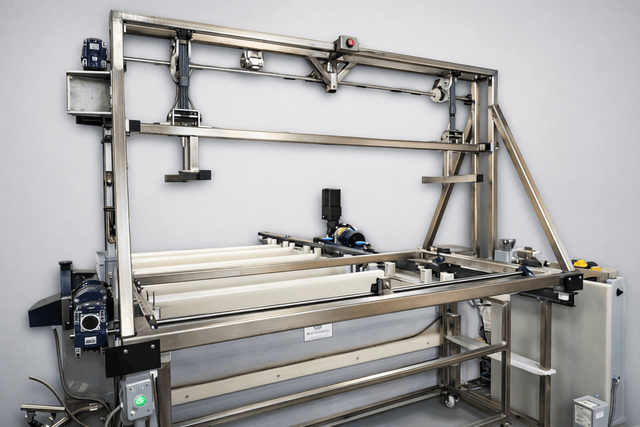
automated electropolishing system

A semi automated electropolishing system can move production loads through cleaning, electropolishing, rinsing, and drying stages with greater consistency while reducing repetitive manual handling.

However, automating electropolishing requires more than installing a material-handling system above a series of tanks. Electropolishing is an electrochemical process. The parts, racks, flight bars, electrical contacts, cathodes, rectifier, electrolyte, temperature, process time, and total exposed surface area must function as one coordinated system.

A part fitting inside the tank does not necessarily mean every surface can be electropolished evenly. The cathodes are positioned along the sides of the tank, and the parts must be arranged so the surfaces being processed have a clear electrical path to them. Tubular cathodes help distribute current around exposed surfaces and reduce shadowing, but one part can still block another if the rack is loaded too tightly or the parts are positioned incorrectly. Proper spacing and orientation are therefore essential to achieving consistent results and will still need some manual imput.

Best Technology designs custom automation systems for metal finishing, including rail-mounted gantry systems for electropolishing and associated cleaning and rinsing processes.

For most electropolishing applications, the practical solution is a semi-automated system rather than a completely automated process. The gantry can automate lifting, movement, immersion timing, and transfer between tanks, but an operator may still need to confirm that the parts are properly spaced and oriented, verify the rack load, and adjust the rectifier when the total surface area changes. This distinction should be established before the system is designed because electropolishing cannot be automated in the same manner as a more repeatable passivation or chemical conversion coating process.

Why Electropolishing Is Typically Semi-Automated

A fully automated electropolishing process is only practical when every production load remains consistent. The same parts must be placed on the rack in the same quantity and configuration, creating the same total exposed surface area for each cycle. This allows the system to use the same validated rectifier settings and process recipe from one load to the next.

In most production environments, that level of consistency is difficult to maintain. Part quantities may change, different components may be processed, or the final rack in a production lot may contain fewer parts. When the total exposed surface area changes, the rectifier output must also be adjusted to maintain the required current density.

For this reason, Best Technology generally approaches electropolishing as a semi-automated process. The gantry can automate lifting, horizontal movement, immersion timing, and transfer between tanks, while the operator confirms the rack load and applies the appropriate rectifier settings. This is especially important for partial racks, which may be overpolished or underpolished if processed using settings established for a full load.

Semi-automation still provides meaningful benefits. Repetitive, hazardous, and timing-sensitive material-handling steps can be automated while the operator retains control over the electrical settings that depend on the parts and total surface area being processed.

Why Manufacturers Automate Electropolishing

Manual electropolishing can be effective for prototyping, lower production volumes, and applications with frequently changing parts. As production volume increases, manual movement and operator-controlled timing can become sources of inconsistency.

Manufacturers may consider semi-automation to:

  • Increase production throughput
  • Handle heavy or difficult-to-move racks
  • Improve immersion and transfer-time consistency
  • Reduce repetitive manual handling
  • Limit operator exposure to heated process chemicals
  • Coordinate rectifier activation with rack position and part movement
  • Create repeatable recipes and process records

Semi-automation can control when a prepared load enters and leaves each tank, how long it remains in each stage, and which validated recipe is used for a particular part family or rack configuration. Before the cycle begins, the operator must confirm that the parts are properly positioned, the rack provides reliable electrical contact, and the rectifier settings match the total surface area being processed.

The objective is not simply to move parts faster. The system must reproduce the electrical, chemical, and thermal conditions established during process development.

How Rail-Mounted Gantry Automation Works

A rail-mounted gantry system moves racks or flight bars horizontally along a multi-stage processing line. The gantry lifts each load, positions it above the required tank, lowers it into the solution, and transfers it to the next stage according to a programmed sequence.

automated electropolishing system

Unlike a conventional overhead crane, Best Technology’s rail-mounted automation is supported by the processing-line structure. This can reduce the need for extensive building modifications while providing controlled movement above the tanks.

A typical line may include precleaning, rinsing, electropolishing, drag-out recovery, neutralization when required, final rinsing, drying, and load and unload stations. The exact sequence depends on the alloy, electrolyte, initial surface condition, part geometry, required finish, and downstream operations.

Depending on system design, the programmable logic controller, or PLC, controls may manage transfer sequences, dwell times, rectifier activation, temperature, agitation, exhaust, alarms, and recipe selection. The operator may still need to confirm that the selected rectifier settings match the total surface area of the prepared rack. Multiple loads may be processed at different stages simultaneously when equipment layout, tank availability, and process timing permit.

Best Technology’s automated passivation case study provides an example of how rail-mounted gantry automation can coordinate part movement through a multi-stage chemical processing line.

Why Electropolishing Requires Specialized Racks and Flight Bars

Many automated cleaning systems are designed around a basket selected by the customer. Semi-Automated electropolishing is different because the system must be designed around an electrically conductive flight bar and the rack attached to it.

The rack must hold the parts securely, maintain the required spacing and orientation, provide drainage, preserve a clear electrical path or line of sight between the part surfaces and the cathode tubes or sheets, and fit within the equipment. It must also conduct current to every part, carry the required electrical load, and maintain reliable contact throughout the electropolishing cycle.

At the electropolishing tank, the flight bar must seat correctly in powered saddles or cradles that connect the rack and parts to the rectifier. The flight-bar ends, rack flanges, contact surfaces, tank, and semi-automation system must therefore be designed together.

A flight bar may be mechanically suitable for lifting but unsuitable for electropolishing if it cannot provide a stable electrical connection. Rack and flight-bar design should begin during process development, not after the equipment has been built.

Electrical Contact and Part Positioning

Simply placing a metal component on a conductive rack may not provide reliable electrical contact under production conditions.

Parts may shift slightly during movement or immersion. Contact areas may also collect oxide, residue, or electrolyte buildup. Increased electrical resistance can contribute to inconsistent polishing, localized heating, arcing, incomplete processing, or visible contact marks.

Racks may use defined contact points, secured or spring-loaded contacts, replaceable tips, or multiple contacts for larger parts. Contact surfaces must also be inspected and cleaned as part of routine maintenance.

Because the contacted area may not polish in the same way as the fully exposed surface, the contact should normally be positioned where any resulting mark is acceptable.

Production testing should confirm that the rack maintains stable contact after repeated loading, processing, rinsing, and unloading cycles.

Cathode Placement, Part Shielding, and Current Distribution

During electropolishing, the part serves as the anode and is connected to the positive side of a DC rectifier. Cathodes positioned in the tank complete the electrical circuit.

Current distribution is influenced by part geometry, electrode spacing, cathode placement, electrolyte conditions, and the position of other parts and rack components.

This is sometimes described as a line-of-sight consideration. More precisely, nearby parts or rack components can shield areas of the workpiece and alter the electrical field and current density reaching those surfaces. A shielded or recessed area may therefore polish differently from a surface positioned closer to or more directly opposite a cathode.

Complex parts may require adjusted spacing, strategically positioned cathodes, or custom auxiliary cathodes to improve current distribution.

Parts should not be packed onto a rack solely to maximize quantity. Increasing load density can change current distribution, electrolyte movement, gas release, drainage, and finished-part consistency. The system should be designed around representative production racks rather than an idealized single part.

Total Surface Area Determines Rectifier Requirements

The current required for electropolishing is closely related to the total exposed surface area of the production load and the required current density.

This generally requires calculating the exposed surface area of each part and multiplying it by the number of parts on the rack. Electrically exposed portions of the rack may also need to be considered.

The maximum anticipated surface area is an important factor in determining rectifier capacity. Surface area, current density, process time, alloy, electrolyte, and required material removal must be evaluated together.

Best Technology provides an electropolishing cycle and current calculator for preliminary estimates. Final rectifier sizing and process settings should be established through testing with the actual parts, rack, electrolyte, and required finish.

Electrolyte Volume and Temperature Control

The electrolyte provides the conductive path between the parts and cathodes, but it is also part of the system’s thermal-management requirements.

Electropolishing generates heat, and the electrolyte must remain within the temperature range established for the process. Tank volume, electrical load, cycle frequency, heat loss, agitation, heating, and cooling requirements can all affect temperature stability.

A higher electrical load or frequent production cycles may require greater attention to electrolyte volume and active temperature control. For this reason, the electropolishing tank is often a significant part of the overall processing line.

Tank sizing should be based on the parts, racks, cathode arrangement, required clearances, electrolyte operating conditions, production rate, and thermal requirements rather than rectifier capacity alone. 

Rectifier Settings Must Match the Load

The rectifier must be coordinated with total surface area, required current density, electrical contact, electrolyte temperature, and process time.

Depending on the equipment and control design, the system may manage current, voltage, electrical limits, process duration, and recipe-specific settings. Interlocks may also be used to coordinate rectifier operation with rack position and part-transfer sequences.

More current or a longer process time does not necessarily produce a better result. Excessive processing can remove too much material, affect tolerances, produce uneven results, or damage critical features. Insufficient current density or process time may not produce the required finish.

Changing the number of parts, total surface area, rack configuration, contact arrangement, cathode positioning, or part geometry may require different validated settings. 

Managing Partial Racks and End-of-Lot Loads

Some manufacturers standardize rack loading so each full rack presents approximately the same total exposed surface area and electrical demand. Different part types may sometimes be combined to reach a defined load, provided the arrangement and process have been validated.

The challenge often occurs at the end of a production lot. A partial rack has less total surface area than a full rack. Processing it with settings established for a full load may apply greater current per unit of part surface area and overprocess the parts.

A partial rack may be processed using separately established rectifier settings, but the operator must recognize the reduced load and adjust the amperage accordingly. The system cannot apply the correct settings unless the load condition has been identified before the cycle begins.

Operator involvement is therefore required when the part quantity or total surface area changes, even though the gantry can continue to automate the material-handling sequence.

Process Time, Cleaning, and Rinsing

Electropolishing time must be sufficient to achieve the required surface improvement without removing excessive material. The appropriate cycle depends on the alloy, initial surface condition, desired finish, current density, electrolyte composition and temperature, part geometry, cathode arrangement, agitation, and dimensional tolerances.

The electropolishing stage may be one of the longest stages in the line. Other racks may continue through cleaning, rinsing, or drying while one load remains in the electropolishing tank. Throughput calculations should therefore consider the entire process rather than only gantry travel speed.

Electropolishing cannot compensate for inadequate precleaning. Oils, polishing compounds, fingerprints, oxides, and other contamination can interfere with electrical contact or prevent the electrolyte from interacting consistently with the surface. Depending on the soils and cleanliness requirements, the system may incorporate aqueous cleaning chemistries or other industrial parts-washing processes before electropolishing.

After electropolishing, parts and racks must drain and rinse effectively so concentrated electrolyte is not carried into later tanks. The semi-automated sequence may control lift speed, drain time, drip positions, transfer delays, and rinse duration, while agitation may be controlled within the applicable process tanks.

Best Technology provides electropolishing electrolyte solutions as well as custom equipment, allowing the chemistry, tanks, material handling, electrical system, and controls to be evaluated together.

How to Evaluate an Semi-Automated Electropolishing Application

Automated Electropolishing System

The evaluation should begin by documenting:

  • Part drawings, dimensions, alloy, geometry, and exposed surface area
  • Initial surface condition and required final result
  • Parts per rack, loads per shift, and production volume
  • Expected variation in part quantity, rack loading, and total surface area between production loads
  • Material-removal limits and critical dimensional tolerances
  • Electropolishing chemistry, temperature, current density, and process time
  • Rectifier, rack, electrical-contact, and cathode requirements
  • Cleaning, rinsing, drainage, and drying requirements
  • Available floor space, utilities, ventilation, and environmental requirements
  • Inspection, documentation, and validation requirements

Representative parts should then be tested using the proposed rack, electrical contacts, cathode arrangement, electrolyte, current density, temperature, agitation, and process time.

Testing should confirm that the required finish can be achieved, material removal remains within tolerance, recessed or shielded surfaces are acceptable, contacts remain stable, parts drain and rinse properly, and results can be repeated across production racks.

A controlled production trial can then confirm throughput, rack durability, electrolyte behavior, temperature stability, and finished-part consistency. Best Technology also provides process validation, equipment training, and support services for manufacturing equipment and chemical processes.

Semi-Automated Electropolishing Is a Complete Process-Design Project

A semi-automated electropolishing line should not be treated as a standard tank system with a gantry crane added afterward as a separate material-handling component. Instead, rail-mounted gantry semi-automation should be integrated into the electropolishing process design.

The system must coordinate part handling, powered flight bars, rack design, electrical contact, cathode placement, current distribution, rectifier capacity, surface area, electrolyte conditions, process time, cleaning, rinsing, throughput, controls, and operator involvement.

A weakness in any one of these areas can affect the finished surface or interrupt production.

Best Technology designs large-scale electropolishing systems around customer-specific part geometry, production volume, material, rectifier requirements, tank size, and cathode placement. For smaller production applications or process development, Best Technology also offers custom electropolishing wet benches.

Plan Semi-Automation Around the Parts and Process

Semi-automated electropolishing can improve consistency, throughput, operator safety, and process control. These benefits depend on designing the system around the actual parts and validated process requirements.

Early testing provides time to establish the rack design, electrical contacts, cathode arrangement, rectifier settings, electrolyte conditions, tank requirements, and process recipe before the production line is built.

Best Technology can evaluate the parts, production requirements, existing process, facility constraints, and desired level of automation to develop a custom electropolishing system for high-volume manufacturing.

Contact an electropolishing expert to discuss an automated electropolishing system or arrange application testing using representative production parts. 
Latest News & Products from Best Technology

Industrial vapor-only degreasing machine

Vapor Degreasing Equipment and Ultrasonic Vapor Degreasers

Industrial Precision Cleaning Solutions Best Technology supplies industrial vapor degreasing equipment for manufacturers requiring reliable, repeatable precision cleaning. Our vapor degreasers are configured around each customer's application, including part dimensions, contaminants, cleaning requirements, solvent selection, and production throughput. [joli-toc] We offer equipment solutions ranging from [...]

Read More

Read More

Trusted By Thousands of Customers Since 1992

  • Industrial Parts Washers
    • Products
      • Agitated Immersion Heated Parts Washer
      • Automatic Parts Washer System with Conveyor
      • Phosphating Lines
      • Automated Phosphate Lines for High-Volume Powder Coat Pre-Treatment
      • Oil Removal Systems
    • Case Studies
      • Pipe Washing Equipment
      • Designing a Phosphate Line for Today’s Process and Tomorrow’s Needs
      • Machine Shop Parts Washer for True Oil
      • Automotive Parts Washer System
  • Ultrasonic Cleaning Systems
    • Product Information
      • How Clean is Clean?
      • How Do Ultrasonic Cleaners Work?
      • What is an Azeotrope?
    • Products
      • Benchtop Ultrasonic Cleaner
      • Benchtop Ultrasonic Parts Cleaning Multi-Tank Systems
      • Ultrasonic Cleaning Consoles
      • Automated Ultrasonic Parts Cleaning Equipment Wash-Rinse-Dry
      • Automated Ultrasonic Cleaning System for High-Volume Production
      • Large Ultrasonic Parts Cleaner with Agitated Immersion
      • Immersible Ultrasonic Transducers
    • Case Studies
      • Automated Pickling and Cleaning System Case Study
      • Automated Ultrasonic Injection Mold Cleaner System
      • 3D Printer / FDM Parts Post Process Ultrasonic Cleaning
      • Machine Shop Parts Washer for Swiss and CNC Precision Parts
  • Vapor Degreasing Systems
    • Product Information
      • What Is Vapor Degreasing?
    • Products
      • Vapor Degreasing Systems
      • Vapor Degreasing Equipment and Ultrasonic Vapor Degreasers
    • Case Studies
      • Vapor Degreaser for Medical Device Instruments
  • Passivation Equipment
    • Product Information
      • What is Passivation? How Does It Work?
      • Nitric vs. Citric Acid Passivation
      • Passivation with Citric Acid
      • What Is Pickling of Stainless Steel? How Do Descaling, Pickling and Etching Work?
      • Passivation Cost Savings Calculator
    • Products
      • Benchtop Ultrasonic Passivation Equipment
      • Passivation Wet Bench for Citric / Nitric Acid
      • Ultrasonic Automated Passivation Equipment
      • Automated Passivation Systems for High-Volume Production
      • Agitated Immersion Multi-Tank Passivation Systems
      • Salt Fog and Humidity Test Chambers for Reliable Corrosion and Environmental Testing
    • Case Studies
      • Case Study: Bringing Citric Acid Passivation In-House for Stainless Steel Medical Device Parts
      • Automated Ultrasonic Passivation System for Medical Device Parts
      • Cleanroom Space Saving Automated Passivation System
      • Heated Polypropylene Passivation and Rinse Tanks
      • Applicable Articles
  • Electropolishing Equipment
    • Product Information
      • What is Electropolishing? How Does Electropolishing Work?
      • Electropolishing Cycle and Current Calculator
      • Passivation vs. Electropolishing
    • Products
      • Tabletop Electropolishing Equipment & Electropolishing Machines
      • Electropolishing Wet Benches
      • Semi-Automated Electropolishing Systems for High-Volume Production
      • Large Scale Part Electropolishing Systems
    • Case Studies
      • EP System – Open Top Wet Bench with Spray Rinse
  • Surface Finishing Systems
    • Alodine Lines
      • Chem Film Equipment for Chromate Conversion Coating
      • What is Alodine® / Chem Film / Chromate Conversion Coating?
      • Alodine Chem Film Tank Line
      • Ready to Set Up a Chem Film (Alodine) Line?
      • Automated Chem Film (Alodine) Systems
      • Hex Chrome Phase Out and Alternatives for Conversion Coating
      • Salt Fog and Humidity Test Chambers for Reliable Corrosion and Environmental Testing
    • Mass Finishing Machines
      • Centrifugal Barrel Finishing Machines
      • Vibratory Bowl Polishers
    • Titanium Anodizing
      • Titanium Anodizing Systems
      • What is Titanium Anodizing?
      • Titanium Anodizing Equipment
  • Automation Systems
    • Product Information
      • What Is Process Automation for Metal Finishing?
    • Products
      • Rail-Mounted Gantry Crane Automation
      • Automated Passivation Systems for High-Volume Production
      • Automated Chem Film (Alodine) Systems
      • Semi-Automated Electropolishing Systems for High-Volume Production
      • Automated Ultrasonic Cleaning System for High-Volume Production
      • Automated Phosphate Lines for High-Volume Powder Coat Pre-Treatment
      • Ultrasonic Automated Passivation Equipment
    • Case Studies
      • Automated Passivation for High-Volume Production: Case Study
      • Automated Pickling and Cleaning System Case Study
  • Wet Benches
    • Product Information
      • What is a Fume Hood? How Do Fume Hoods Work?
    • Products
      • Fume Hoods
      • Wet Benches for Semiconductor & FM4910 Applications
      • Wet Benches for Citric / Nitric Passivation of Stainless Steel and Titanium
      • Wet Benches for Electropolishing
      • Cascade Overflow Rinse Tanks
      • Quick Dump Rinse Tank
    • Case Studies
      • Semiconductor Chemical Processing Wet Bench and Fume Hood
  • Specialty & Custom Industrial Process Systems
    • Products
      • Automated Chemical Neutralization Tank Cart
      • Salt Fog and Humidity Test Chambers
      • Vapor and Dryfilm PTFE Coating Systems
      • Heated Hot Air Parts Dryer
      • Solvent Recovery Equipment
  • Chemicals, Solvents & Fluids
    • Precision Cleaning Solvents
      • BestSolv® Engineered Fluids
      • Solvent Cleaning with BestSolv® Engineered Fluids
      • 3Mâ„¢ Novecâ„¢ Replacement Fluids
    • Aqueous Cleaning
      • Aqueous Cleaning Solutions: Alkaline Cleaners
    • Surface Finishing Chemicals
      • CitriSurf Passivation Chemistry for Citric Acid Passivation
      • Electropolishing Solutions: Electrolyte Chemicals
      • Conversion Coating Chemistry
  • Process Validation Templates
  • Equipment Financing
Best Technology applications engineer

Connect with Our
Experts Today!

Ready to boost your manufacturing process efficiency?

Our expert team is just a click away. Reach out now to get personalized advice on choosing the best system for your specific needs. Let's enhance your operations together!

Contact an Expert
Best Technology Inc.

Best Technology Inc.
14040 23rd Avenue N.
Minneapolis, MN 55447

phone icon612.392.2414

Follow Us
  • Facebook icon
  • X icon
  • LinkedIn icon
  • YouTube icon
  • Pinterest icon

Quick Links

  • Product Line Card
  • Case Studies
  • Videos
  • Site Map
  • Equipment Financing
  • Contact Us

Products

  • Industrial Parts Washers
  • Ultrasonic Cleaning Systems
  • Passivation Equipment
  • Electropolishing Equipment
  • Surface Finishing Systems
  • Chemistries, Solvents & Fluids

Industries Served

  • Medical Device
  • Aerospace
  • Electronics
  • Automotive
Contact an Expert

Copyright © 2026 · Best Technology Inc. · Privacy Policy

Precision Cleaning, Passivation & Finishing Systems
Contact an Expert
612.392.2414
  • facebook
  • Twitter
  • LinkedIn
  • YouTube
  • Pinterest

"*" indicates required fields

1Contact Info
2Your Project

Start Here for the Best Solution

Are you looking to purchase equipment?*
Note: We specialize in custom metal finishing equipment and do not offer job shop or contract services.
Best Technology designs custom metal finishing equipment for commercial manufacturing environments. Hobby, student, or consumer projects are not supported.
Are you looking for budgetary pricing or a formal quote?
How soon are you looking to purchase equipment?
Has this project received internal approval at your organization?
Are you currently doing this process in-house or sending it out to a vendor?