

Hydrofluoroether (HFE) fluids are specialty fluorinated liquids used in precision cleaning, vapor degreasing, heat transfer, electronics, carrier-fluid applications, and other industrial processes where properties such as non-flammability, low surface tension, dielectric performance, and material compatibility can be important.
You may also see them described as HFE solvents, hydrofluoroether solvents, HFE solutions, or simply HFE fluids.
Although HFEs are widely associated with solvent cleaning, cleaning is only one part of the story. Different HFE fluids can be used to clean precision components, move heat away from sensitive electronics, carry lubricants or coatings onto a surface, or support specialized laboratory and manufacturing processes.
For manufacturers evaluating older fluorinated chemistries, HFE fluids can also provide a transition path from discontinued legacy fluids or certain higher-global-warming-potential hydrofluorocarbon (HFC) fluids.
Explore BestSolv® Engineered Fluids
What Does HFE Mean?
HFE stands for hydrofluoroether.
Hydrofluoroethers are a family of fluorinated organic compounds containing an ether linkage, which means an oxygen atom is positioned between carbon-containing groups within the molecule.
That molecular structure helps create the physical properties that make certain HFEs useful in demanding industrial applications.
Depending on the specific HFE, these properties may include:
- Non-flammability
- Low surface tension
- Low viscosity
- Electrical non-conductivity
- Rapid evaporation
- Compatibility with many metals, plastics, and elastomers
- Chemical and thermal stability
- Zero ozone depletion potential
- Lower global warming potential than certain legacy fluorinated fluids
The important point is that HFE is a chemical family, not one individual product.
Different HFE molecules have different boiling points, densities, surface tensions, solvency characteristics, and operating ranges. Those differences determine which HFE is appropriate for a particular process.
A Simple Way to Think About HFE Fluids
Calling something an HFE is a little like calling something an alcohol.
The name tells you what general family of chemistry you are dealing with, but it does not tell you everything about how that particular liquid will behave.
For engineers, the specific molecule and its physical properties matter just as much as the HFE designation itself.

Why Are HFE Fluids Useful?
HFEs became important because certain industrial processes require a combination of properties that conventional liquids cannot always provide.
Consider a tightly assembled electronic component.
A cleaning fluid may need to:
- Reach underneath components and into very small spaces
- Be compatible with delicate materials
- Evaporate without leaving significant residue
- Avoid creating an electrical hazard
- Work within an existing cleaning process
Now consider an electronics cooling system. Cleaning is no longer the objective, but electrical compatibility and thermal behavior may still make an HFE useful.
This combination of characteristics is why the same broad family of chemistry appears in applications that initially seem unrelated.
Common Uses for Hydrofluoroether Fluids
Precision Cleaning and Vapor Degreasing
HFE solvents are commonly used for precision cleaning and vapor degreasing where sensitive components, complex geometries, or strict residue requirements make solvent selection important.

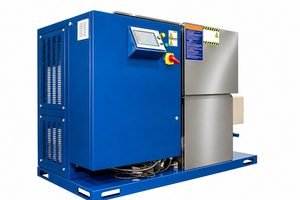
Floor-Standing Vapor Degreasers for Full-Scale Production vapor degreasing
Low surface tension can allow the fluid to penetrate tight spaces and small features that are difficult for higher-surface-tension liquids to reach.
Depending on the formulation, HFE-based fluids can be used for cleaning:
- Precision metal components
- Electronics
- Medical device components
- Aerospace parts
- Optical components
- Semiconductor-related hardware
Some products are neat HFE fluids, meaning the fluid is essentially 100% HFE, while others combine an HFE component with additional active ingredients to provide greater solvency for oils, greases, fluxes, and other manufacturing soils. It’s worth noting that the HFE component makes the vapor degreasing solvent non-flammable.
Learn more about BestSolv® solvent cleaning and vapor degreasing fluids.
Electronics and Semiconductor Applications
Many HFE fluids are electrically non-conductive, making them useful where conventional conductive liquids may not be appropriate.
Depending on the chemistry and process, HFEs can support:
- Electronics cleaning
- Semiconductor manufacturing
- Electrical and reliability testing
- Temperature-control processes
- Direct-contact thermal applications
- Specialized rinsing and drying
When electronics can remain operational or be tested while in contact with the fluid, dielectric behavior becomes an especially valuable property.
Heat Transfer and Thermal Management
HFE fluids are not limited to cleaning.
Certain HFEs are also used as heat-transfer fluids because they combine useful thermal characteristics with electrical non-conductivity.
They may be considered for specialized chillers, semiconductor equipment, electronics cooling, reliability testing, and other systems where water, glycol, or conventional oils do not meet the application requirements.

Immersion cooling for data centers
Different HFEs have different boiling points and operating ranges, so fluid selection needs to match the thermal-management system.
Learn more about BestSolv® thermal-management and heat-transfer fluids.
Carrier Fluid Applications
In some applications, the HFE does not clean the surface at all.
Instead, it acts as a carrier fluid.
A carrier fluid temporarily transports another material, such as a lubricant, silicone, coating, corrosion inhibitor, or other active chemistry, across a surface. The carrier then evaporates, leaving the intended material behind.
Low viscosity, wetting behavior, and clean evaporation can make certain HFE fluids useful for these controlled-deposition processes.
Learn more about carrier fluids for precision deposition and material transport.
Latent Fingerprint Processing
HFE carrier fluids are also used in forensic laboratories.
In latent fingerprint processing, the fluid can carry fingerprint-development chemistry such as ninhydrin or other active ingredients across evidence surfaces before evaporating.
This is a good example of why the consistency of the underlying HFE chemistry can matter even when the HFE itself is not the primary active ingredient.
Learn more about BestSolv® fluids for latent fingerprint processing.
Neat HFE Fluids vs. HFE-Based Blends
Not every product containing an HFE should be described simply as a single-isomer HFE fluid.
There are two important categories.
Neat HFE Fluids
A neat HFE fluid is the hydrofluoroether itself without secondary active solvent ingredients.
HFE-Based Solvent Blends
Other engineered fluids use an HFE as the foundational component while incorporating secondary active ingredients.
Those additional ingredients can modify properties such as solvency and allow the finished formulation to remove soils that a neat HFE alone may not address as effectively.
When discussing these formulations, it is more technically accurate to refer to the HFE component or HFE portion of the blend.
That distinction becomes especially important when discussing single-isomer chemistry.
What Is a Single-Isomer HFE?
An isomer is a molecule that has the same molecular formula as another molecule but a different arrangement of its atoms.
Two isomers can therefore contain the same types and numbers of atoms while still having slightly different molecular structures.
Legacy HFE production could produce mixtures containing more than one isomer. Modern targeted synthesis can instead produce a high-purity single-isomer HFE.
Why does that matter?
For industrial processes, the strongest benefit is not necessarily greater cleaning strength. According to Best Technology’s chemical team, solvency and Kauri-Butanol (KB) values can remain equivalent to the legacy mixtures.
Instead, the advantage is greater control over the chemistry itself.
BestSolv® offers neat single-isomer HFE options, including BestSolv® 7100, BestSolv® 7200, and BestSolv® 7300.
Three Advantages of BestSolv® Single-Isomer HFE Chemistry
1. Higher Chemical Consistency
High-purity single-isomer HFE eliminates isomer-ratio drift, supporting repeatable chemistry from one production lot to the next.
For engineers, this can support greater process consistency.
For procurement teams, it means the chemistry being purchased is based on a controlled single-isomer manufacturing pathway rather than a varying ratio of multiple isomers.
In HFE-based solvent blends, this advantage applies specifically to the HFE component of the formulation.
2. Compliant Synthesis
BestSolv® single-isomer HFE chemistry is produced through targeted catalytic synthesis rather than legacy electrochemical fluorination, or ECF.
Legacy ECF manufacturing was associated with the generation of long-chain PFAS byproducts.
Targeted catalytic synthesis avoids the generation of those long-chain PFAS manufacturing byproducts while producing the desired high-purity HFE isomer.
Learn more about single-isomer HFE chemistry and its manufacturing advantages.
3. Drop-In Process Continuity
BestSolv® single-isomer HFE contains the primary isomer found in legacy HFE fluids and is designed to maintain comparable standard physical characteristics such as:
- Boiling point
- Surface tension
- Material compatibility
This can support transition into existing applications without requiring equipment redesign when the selected replacement is appropriate for the legacy fluid and process.
For blends, the same concept should be applied to the HFE component rather than describing the entire formulated product as a single-isomer fluid.
Why Choose Single-Isomer HFE Chemistry?
The main advantages of single-isomer HFE chemistry are consistency, controlled synthesis, and continuity with established HFE processes.
- More consistent HFE composition
- Elimination of isomer-ratio variation
- A targeted manufacturing pathway
- Avoidance of long-chain PFAS byproducts associated with legacy ECF production
- Continuity with established HFE process characteristics
Can HFE Fluids Replace Legacy 3M™ Novec™ Fluids?
In many applications, yes, but the correct replacement depends on the specific Novec™ fluid and the process in which it was used.
Manufacturers replacing discontinued legacy HFE fluids may need to preserve properties such as:
- Chemical composition
- Boiling point
- Surface tension
- Material compatibility
- Dielectric characteristics
- Evaporation behavior
- Process temperature
Best Technology offers BestSolv® alternatives for discontinued 3M™ Novec™ engineered fluids, including options intended to maintain established HFE process characteristics.
For example, BestSolv® 7100 and BestSolv® 7200 are single-isomer options, available for applications historically using corresponding legacy HFE fluids, such as 3M™ Novec™ 7100 and 3M™ Novec™ 7200.
Can HFE Fluids Be an Alternative to HFC Fluids Such as Vertrel™ XF?
Vertrel™ XF is a hydrofluorocarbon, or HFC, fluid used in vapor degreasing, precision cleaning, rinsing, drying, heat-transfer, carrier-fluid, and dielectric applications. HFC fluids are being progressively phased down due to government regulations aimed at reducing high-GWP greenhouse gases, making lower-GWP alternatives increasingly important for the long term.
Hydrofluoroether, or HFE, fluids can provide an alternative for manufacturers looking to move away from HFC-based fluids, offering lower global warming potential while still supporting many of the performance characteristics established cleaning and specialty-fluid applications depend on.
Best Technology offers several BestSolv® HFE fluids that can be evaluated as alternatives to Vertrel™ XF, including BestSolv® 7100 and BestSolv® Sierra for precision cleaning, vapor degreasing, rinsing, and related applications.
An HFE is not automatically a universal drop-in replacement for an HFC. Making the right switch depends on real engineering variables — things like boiling point, material compatibility, evaporation characteristics, and your existing equipment configuration all factor into whether a given fluid is the right fit for your specific process. That’s the kind of match our chemical team works through with manufacturers every day.
If you’re also interested in moving toward PFAS-free chemistry as part of this transition, Best Technology offers BestSolv® Omega and BestSolv® Zeta, PFAS-free solvent options built for precision cleaning and related applications.
Are HFE Fluids PFAS?
Traditional HFE chemistry should not automatically be called PFAS-free. Even if modern manufacturing avoids creating long-chain PFAS byproducts, the HFE molecule itself may still fall under broad PFAS definitions.
The molecular structure of these HFEs includes hydrogen-containing ether groups that allow them to react in the atmosphere. When released, they primarily move into the air, where naturally occurring OH radicals begin breaking them down. Their atmospheric lifetimes vary depending on the specific HFE molecule, so they may remain in the atmosphere for some time but are not environmentally inert.
For manufacturers that need to maintain HFE chemistry, Best Technology offers options such as BestSolv® 7100, BestSolv® 7200, and BestSolv® 7300, as well as HFE-based blends such as BestSolv® 72DA and BestSolv® 73DE. Best Technology also offers 3M™ Novec™ replacement options. BestSolv® 7100, 7200, and 7300 are HFE fluids, while 72DA and 73DE are HFE-based formulations.
For companies specifically seeking PFAS-free chemistry, Best Technology also offers HFO and HCFO solvent alternatives, including BestSolv® Zeta and BestSolv® Omega.
The right path depends on whether the priority is maintaining an established HFE process, reducing environmental impact, or transitioning to PFAS-free chemistry.
How Do You Select the Right HFE Fluid?
There is no universal HFE fluid for every application.
Start with what the fluid must accomplish.
For Cleaning
Evaluate the soil, required solvency, substrate compatibility, drying requirements, KB value where applicable, vapor-degreasing equipment, and cleanliness specification.
For Legacy Fluid Replacement
Compare the physical characteristics that matter to the validated process, including boiling point, surface tension, material compatibility, solvency, and dielectric behavior.
For Heat Transfer
Evaluate operating temperature, boiling point, dielectric requirements, flow characteristics, thermal stability, and system design.
For Carrier Applications
Consider compatibility with the material being carried, wetting behavior, evaporation profile, residue requirements, and process validation.
For Environmental or Regulatory Objectives
First define the actual objective.
Are you trying to:
- Replace a discontinued Novec™ fluid?
- Transition away from an HFC?
- Reduce GWP?
- Avoid a specific regulated substance?
- Move to PFAS-free chemistry?
- Preserve an already validated process?
Those questions can lead to different solutions.
Need Help Choosing an HFE Fluid or Alternative?
Choosing an engineered fluid is not simply a matter of matching product names.
The correct choice depends on the process, existing equipment, required physical properties, material compatibility, environmental objectives, and validation requirements.
Explore BestSolv® Engineered Fluids or contact Best Technology to discuss your application.
Best Technology’s chemical application specialists can help evaluate an existing HFE or HFC process and identify an appropriate BestSolv® HFE fluid, HFE-based formulation, or next-generation alternative.

 612.392.2414


