Best Technology

Precision Cleaning, Passivation & Finishing Systems

Call Us612.392.2414
Contact an Expert
  • Equipment
    • Industrial Parts Washers
    • Ultrasonic Cleaning Systems
    • Vapor Degreasing Systems
    • Passivation Equipment
    • Electropolishing Equipment
    • Chem Film Equipment
    • Titanium Anodizing Systems
    • Mass Finishing Machines
    • Automation Systems
    • Wet Benches
    • Specialty & Custom Industrial Process Systems
  • Chemicals
    • Chemicals, Solvents & Fluids
    • BestSolv® Engineered Fluids
    • 3M™ Novec™ Replacement Fluids
    • 3M™ Novec™ Engineered Fluids, Chemicals, & Solvents
    • 3M™ Novec™ HFE Engineered Fluids and PFAS Phase Out
  • Industries
  • Articles
    • FAQ – Frequently Asked Questions
    • Ultrasonic Cleaning
      • How Do Ultrasonic Cleaners Work?
    • Passivation
      • What is Passivation?
    • Electropolishing
      • What is Electropolishing?
    • Surface Finishing
      • What is Alodine® / Chem Film / Chromate Conversion Coating?
      • What is Titanium Anodizing?
    • Industrial Parts Washers
    • Automation Systems
  • Case Studies
    • Industry Applications
    • Industrial Parts Washer Case Studies
    • Passivation Systems Case Studies
    • Part Cleaning Case Studies
    • Part Finishing Equipment Case Studies
    • Ultrasonic Cleaning Systems Case Studies
  • Testimonials
  • About Us
  • Contact Us
  • Equipment
    • Industrial Parts Washers
      • Products
        • Agitated Immersion Heated Parts Washer
        • Automatic Parts Washer System with Conveyor
        • Phosphating Lines
        • Automated Phosphate Lines for High-Volume Powder Coat Pre-Treatment
        • Oil Removal Systems
      • Case Studies
        • Pipe Washing Equipment
        • Designing a Phosphate Line for Today’s Process and Tomorrow’s Needs
        • Machine Shop Parts Washer for True Oil
        • Automotive Parts Washer System
    • Ultrasonic Cleaning Systems
      • Product Information
        • How Clean is Clean?
        • How Do Ultrasonic Cleaners Work?
        • What is an Azeotrope?
      • Products
        • Benchtop Ultrasonic Cleaner
        • Benchtop Ultrasonic Parts Cleaning Multi-Tank Systems
        • Ultrasonic Cleaning Consoles
        • Automated Ultrasonic Parts Cleaning Equipment Wash-Rinse-Dry
        • Automated Ultrasonic Cleaning System for High-Volume Production
        • Large Ultrasonic Parts Cleaner with Agitated Immersion
        • Immersible Ultrasonic Transducers
        • Vapor Degreasing Systems
        • Vapor Degreasers
      • Case Studies
        • Automated Pickling and Cleaning System Case Study
        • Automated Ultrasonic Injection Mold Cleaner System
        • 3D Printer / FDM Parts Post Process Ultrasonic Cleaning
        • Machine Shop Parts Washer for Swiss and CNC Precision Parts
        • Vapor Degreaser For Medical Device Instruments
    • Passivation Equipment
      • Product Information
        • What is Passivation? How Does It Work?
        • Nitric vs. Citric Acid Passivation
        • Passivation with Citric Acid
        • What Is Pickling of Stainless Steel? How Do Descaling, Pickling and Etching Work?
        • Passivation Cost Savings Calculator
      • Products
        • Benchtop Ultrasonic Passivation Equipment
        • Passivation Wet Bench for Citric / Nitric Acid
        • Ultrasonic Automated Passivation Equipment
        • Automated Passivation Systems for High-Volume Production
        • Agitated Immersion Multi-Tank Passivation Systems
        • Salt Fog and Humidity Test Chambers for Reliable Corrosion and Environmental Testing
      • Case Studies
        • Case Study: Bringing Citric Acid Passivation In-House for Stainless Steel Medical Device Parts
        • Automated Ultrasonic Passivation System for Medical Device Parts
        • Cleanroom Space Saving Automated Passivation System
        • Heated Polypropylene Acid Passivation and Rinse Tanks
        • Applicable Articles
    • Electropolishing Equipment
      • Product Information
        • What is Electropolishing? How Does Electropolishing Work?
        • Electropolishing Cycle and Current Calculator
        • Passivation vs. Electropolishing
      • Products
        • Tabletop Electropolishing Equipment & Electropolishing Machines
        • Electropolishing Wet Benches
        • Semi-Automated Electropolishing Systems for High-Volume Production
        • Large Scale Part Electropolishing Systems
      • Case Studies
        • EP System – Open Top Wet Bench with Spray Rinse
    • Surface Finishing Systems
      • Chem Film Equipment / Alodine Lines
        • Chem Film Equipment
        • What is Alodine / Chem Film / Chromate Conversion Coating?
        • Alodine Chem Film Tank Line
        • Ready to Set Up a Chem Film (Alodine) Line?
        • Automated Chem Film (Alodine) Systems
        • Hex Chrome Phase Out and Alternatives for Conversion Coating
        • Salt Fog and Humidity Test Chambers for Reliable Corrosion and Environmental Testing
      • Mass Finishing Machines
        • Centrifugal Barrel Finishing Machines
        • Vibratory Bowl Polishers
      • Titanium Anodizing
        • Titanium Anodizing Systems
        • What is Titanium Anodizing?
        • Titanium Anodizing Equipment
    • Automation Systems
      • Product Information
        • What Is Process Automation for Metal Finishing?
      • Products
        • Rail-Mounted Gantry Crane Automation
        • Automated Passivation Systems for High-Volume Production
        • Automated Ultrasonic Cleaning System for High-Volume Production
        • Automated Chem Film (Alodine) Systems
        • Semi-Automated Electropolishing Systems for High-Volume Production
        • Automated Phosphate Lines for High-Volume Powder Coat Pre-Treatment
        • Ultrasonic Automated Passivation Equipment
      • Case Studies
        • Automated Pickling and Cleaning System Case Study
        • Automated Passivation for High-Volume Production: Case Study
    • Wet Benches
      • Product Information
        • What is a Fume Hood? How Do Fume Hoods Work?
      • Products
        • Fume Hoods
        • Wet Bench for Semiconductor & FM4910 Applications
        • Wet Benches for Citric / Nitric Passivation of Stainless Steel and Titanium
        • Wet Benches for Electropolishing
        • Cascade Overflow Rinse Tanks
        • Quick Dump Rinse Tank
      • Case Studies
        • Semiconductor Chemical Processing Wet Bench and Fume Hood
    • Specialty & Custom Industrial Process Systems
      • Automated Chemical Neutralization Tank Cart
      • Salt Fog and Humidity Test Chambers
      • Vapor and Dryfilm PTFE Coating Systems
      • Heated Hot Air Parts Dryer
      • Solvent Recovery Equipment
    • Process Validation Templates
    • Equipment Financing
  • Chemicals, Solvents & Fluids
    • Chemicals, Solvents & Fluids from Best Technology
    • BestSolv® Engineered Fluids
    • Solvent Cleaning Fluids
      • Solvent Cleaning with BestSolv® Engineered Fluids
      • BestSolv® Alpha
      • BestSolv® Bravo
      • BestSolv® Delta
      • BestSolv® Echo
      • BestSolv® Lima
      • BestSolv® Omega: PFAS Free
      • BestSolv® Omega Plus: PFAS-Free
      • BestSolv® Sierra
      • BestSolv® Theta
      • BestSolv® Zeta: PFAS-Free
      • BestSolv® 5408: Boeing Spec BAC 5408 Qualified Cleaning Solvent
      • BestSolv® 7100
      • BestSolv® 7200
      • BestSolv® 7300
      • BestSolv® 71DE
      • BestSolv® 72DA
      • BestSolv® 72DE
      • BestSolv® 73DE
      • BestSolv® nPB: TCE Replacement
      • Latent Fingerprint Processing with BestSolv® Engineered Fluids
      • What Are Hydrofluoroether (HFE) Fluids?
      • Film Cleaning with BestSolv® 7200
      • Oxygen System and Oxygen Gauge Cleaning Solutions
      • Carrier Fluids for Precision Deposition, Wetting, and Material Transport
      • Choosing the Best Vapor Degreaser Solvent
    • Thermal Management / Heat Transfer Fluids
      • Thermal Management / Heat Transfer with BestSolv® Engineered Fluids
      • BestSolv® Zulu Immersion Cooling Fluid
      • BestSolv® Zulu MAG Magnesium Protection Fluid
      • BestSolv® Zulu FS Fire Suppression Fluid
      • BestSolv® 7100
      • BestSolv® 7200
      • BestSolv® 7300
      • BestSolv® 3283
      • BestSolv® 40
      • BestSolv® Fluids as Coolants for Specialized Machinery and Chiller Systems
      • Magnesium Cover Gas, Re-Engineered for Today
      • Gross Leak Testing for Hermetic Components and Critical Assemblies
    • PFAS-Free Next Generation
      • BestSolv® Omega: PFAS-Free
      • BestSolv® Omega Plus: PFAS-Free
      • BestSolv® Zeta: PFAS-Free
      • PFAS-Free Cleaning Solvents for Vapor Degreasing Applications
      • BestSolv® HFO / HCFO Solvents for Precision Cleaning
    • 3M™ Novec™ Replacements
      • 3M™ Novec™ Replacement Fluids
      • 3M™ Novec™ 7100 Replacements
      • 3M™ Novec™ 7200 Replacement
      • 3M™ Novec™ 7300 Replacement
      • 3M™ Novec™ 71DA Replacements
      • 3M™ Novec™ 71DE Replacement Options
      • 3M™ Novec™ 71IPA Replacements
      • 3M™ Novec™ 72DA Replacements
      • 3M™ Novec™ 72DE Replacements
      • 3M™ Novec™ 73DE Replacement
      • Running Out of 3M™ Novec™ Stock? How to Transition to Your BestSolv® Replacement Path
    • 3M™ Novec™ Engineered Fluids and Fluorinert™ Liquids
      • 3M™ Novec™ Engineered Fluids
      • 3M™ Novec™ HFE Engineered Fluids and PFAS Phase Out
      • 3M™ Novec™ Cleaning Solvents
        • Solvent Cleaning with 3M™ Novec™ Engineered Fluids
        • 3M™ Novec™ 7100
        • 3M™ Novec™ 7200
        • 3M™ Novec™ 7300
        • 3M™ Novec™ 71DA
        • 3M™ Novec™ 71DE
        • 3M™ Novec™ 71IPA
        • 3M™ Novec™ 72DA
        • 3M™ Novec™ 72DE
        • 3M™ Novec™ 73DE
      • 3M™ Fluorinert™ and 3M™ Novec™ Heat Transfer and Thermal Management Fluids
        • 3M™ Fluorinert™ Electronic Liquids for Thermal Management / Heat Transfer
        • 3M™ Novec™ 649
        • 3M™ Novec™ 7100
        • 3M™ Novec™ 7200
        • 3M™ Novec™ 7300
    • Solvent Phase Outs
      • 3M™ Novec™ HFE Engineered Fluids and PFAS Phase Out
      • nPB Replacement
      • TCE Replacement
      • Methylene Chloride Replacement
    • Aqueous Cleaning
      • Aqueous Cleaning Solutions: Alkaline Cleaners
      • How Clean is Clean?
    • Surface Finishing Chemicals
      • CitriSurf Passivation Chemistry for Citric Acid Passivation
      • Electropolishing Solutions: Electrolyte Chemicals
      • Conversion Coating Chemistry
      • Hex Chrome Phase Out and Alternatives for Conversion Coating
  • Industries
  • Customer Testimonials
  • About Us
  • Contact Us
Contact an Expert
home Best Technology / BestSolv® Engineered Fluids / Thermal Management / Heat Transfer with BestSolv® Engineered Fluids

Thermal Management / Heat Transfer with BestSolv® Engineered Fluids

Table of contents
  1. BestSolv® Engineered Fluids for Heat Transfer and Thermal Management
  2. BestSolv® Engineered Fluids for Advanced Thermal Management
  3. BestSolv® Thermal Management / Heat Transfer Fluids
  4. BestSolv® Thermal Management Fluids – Operating Range and Boiling Points
  5. Selecting a Thermal Management Fluid
  6. Benefits of BestSolv® Engineered Fluids for Thermal Management
    1. Performance Comparison of BestSolv® Thermal Management Fluids
  7. Properties of BestSolv® Thermal Management Fluids
  8. Material Compatibility for Thermal Management
    1. Polymers
    2. Elastomers
    3. Metals
  9. Immersion Cooling with BestSolv® Fluids
  10. Electronics Reliability Testing with BestSolv® Fluids
  11. Other Uses of BestSolv® Thermal Management Fluids
  12. BestSolv® Medical Device Policy
  13. BestSolv® Thermal Management Fluid Data Sheets
  14. Get Your BestSolv® Fluids Today
  15. BestSolv® Price and Ordering

BestSolv® Engineered Fluids for Heat Transfer and Thermal Management
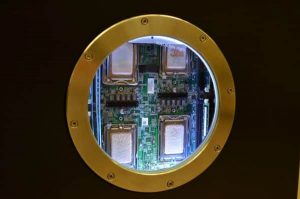
BestSolv fluids for immersion cooling

For manufacturers of semiconductors, maintaining stable process temperatures is critical to product yield and quality. As legacy electronic liquids are phased out, many engineers are actively evaluating a proven Fluorinert alternative that delivers equivalent dielectric performance and thermal stability. In data centers, removing excess heat through immersion cooling dramatically improves efficiency and reduces energy costs. In these environments, selecting a qualified Fluorinert replacement helps maintain uptime, efficiency, and electrical safety without redesigning cooling architectures. With a full range of dielectric fluids, BestSolv® enables engineers to match fluid properties to the exact thermal and electrical requirements of each system.

BestSolv® heat transfer fluids are fluorinated electronic liquids that are safe for direct contact with live electronics and offer a low-maintenance, residue-free alternative to water, glycol, or oil-based cooling systems.

Whether used in cold-plate cooling for semiconductors, immersion cooling for data centers, spray cooling for avionics, or thermal testing for electronic components, BestSolv® thermal management fluids provide efficient heat removal while protecting sensitive circuitry. In high-uptime environments, systems using BestSolv® in reservoirs and recirculation loops can also extend maintenance intervals and improve overall reliability.

BestSolv® Engineered Fluids deliver exceptional cooling performance across a wide operating temperature range—without compromise to worker safety or environmental responsibility. Designed as drop-in solutions, BestSolv® fluids are widely adopted as a reliable Fluorinert substitute for thermal management and dielectric cooling applications. Designed as drop-in replacements for 3M™ Novec™ and Fluorinert™ fluids, BestSolv® products provide the same proven performance with zero ozone depletion potential (ODP), excellent material compatibility, and options that support lower global warming impact.

From supercomputers and semiconductor tools to aerospace and defense electronics, BestSolv® heat transfer fluids deliver both thermal stability and electrical insulation, supporting the performance, safety, and environmental goals of advanced manufacturers worldwide.

BestSolv® Engineered Fluids for Advanced Thermal Management

BestSolv® Engineered Fluids redefine thermal management by giving engineers precise control over heat in next-generation electronic and power systems. Designed for high-efficiency cooling, these non-conductive, non-flammable liquids maintain stable performance under continuous thermal stress while minimizing maintenance and contamination risk. Their versatility allows seamless integration into diverse heat-transfer designs—from immersion cooling to direct contact applications—delivering consistent results across evolving technologies.

Built on decades of industry experience, BestSolv® fluids enable efficient, low-maintenance cooling for systems such as supercomputers, semiconductor tools, power electronics, and aerospace equipment. Each formulation combines high purity with zero ozone depletion potential (ODP), ensuring both performance and sustainability.

With boiling points ranging from approximately 49 °C to 165 °C, the BestSolv® product family gives engineers flexibility to optimize for a wide range of applications. Whether used for immersion cooling, heat transfer, or dielectric testing, these fluids maintain stable performance across wide operating temperature ranges.

For applications demanding maximum electrical insulation and crash-safe operation—such as battery cooling, aerospace, or high-voltage systems—BestSolv® fluids provide an inherently non-flammable and residue-free solution that protects equipment and personnel alike.

BestSolv® Thermal Management / Heat Transfer Fluids

  • BestSolv® Zulu
  • BestSolv® 7100
  • BestSolv® 7200
  • BestSolv® 7300
  • BestSolv® 3283
  • BestSolv® 40

Together, the BestSolv® heat transfer fluids cover the full spectrum of modern thermal management needs, delivering performance, safety, and sustainability without compromise.

BestSolv® Thermal Management Fluids – Operating Range and Boiling Points

The BestSolv® family of heat transfer and immersion cooling fluids delivers dependable, drop-in performance across a broad range of applications. Each fluid is optimized for specific operating conditions—offering precise temperature control, high dielectric strength, and low environmental impact.

ProductChemistry TypeBoiling Point (°C)Typical Operating Range (°C)
BestSolv® ZuluFluorinated ketone (FK-5-1-12)49–75 to 40
BestSolv® 7100Hydrofluoroether (HFE)61–105 to 50
BestSolv® 7200Hydrofluoroether (HFE)76–105 to 65
BestSolv® 7300Hydrofluoroether (HFE)98–30 to 85
BestSolv® 3283Perfluorocarbon (PFC)128-55 to 100
BestSolv® 40Perfluorocarbon (PFC)165-45 to 155

Selecting a Thermal Management Fluid

When selecting a thermal management fluid, it’s critical to evaluate key performance factors to ensure long-term efficiency and system reliability:

When evaluating a thermal management fluid, consider:

  • Operating Temperature Range: Choose a fluid that aligns with your required optimum temperature range, both minimum and maximum process temperatures. This is the primary consideration when selecting a BestSolv® fluid.  As long as the selected thermal management fluid meets your required operating temperature range, it doesn’t need to match your previous fluid exactly.
  • For systems transitioning away from discontinued chemistries, a well-matched Fluorinert alternative ensures performance continuity while expanding long-term sourcing flexibility.
  • Material Compatibility: BestSolv® fluids are designed to be compatible with the most common materials used in thermal management systems. 
  • Viscosity and Flow Characteristics: Our fluids maintain optimal viscosity across wide temperature ranges, ensuring efficient heat transfer and consistent flow performance even in extreme conditions.
  • Thermal Stability & Safety: Every BestSolv® fluid is engineered for high thermal stability and non-flammable operation, delivering safe, dependable performance under demanding thermal loads.

By selecting the BestSolv® fluid that fits your application’s thermal profile, you can achieve optimal performance, longevity, and peace of mind—without being tied to a single legacy chemistry.

Benefits of BestSolv® Engineered Fluids for Thermal Management

BestSolv® Engineered Fluids bring together advanced chemistry and trusted reliability for today’s most demanding cooling and dielectric applications. Each formulation delivers stable, non-flammable performance with high dielectric strength, chemical inertness, and environmental responsibility — ensuring your systems stay efficient, safe, and compliant.

As a modern Fluorinert replacement, BestSolv® fluids provide stable thermal performance, strong dielectric properties, and simplified compliance for advanced electronics cooling.

These specialized electronic liquids are electrically non-conductive and residue-free, making them ideal for direct-contact and immersion cooling where precision and safety are critical. The fluorinated liquid will not damage electronic equipment or integrated circuits in the event of a leak or other failure. Their low viscosity minimizes pumping power in closed-loop chillers, while broad pour-point ranges keep systems running smoothly even at sub-zero temperatures.

Every BestSolv® fluid is engineered to provide:

  • Long-term thermal stability for consistent performance.
  • Zero ozone depletion potential (ODP).
  • Non-corrosive safety and excellent material compatibility across metals, plastics, and elastomers.
  • Worker-safe handling with low toxicity and no special containment requirements.

From semiconductor fabrication and data centers to aerospace electronics and power conversion systems, whether used for immersion cooling, heat transfer, or dielectric testing, BestSolv® fluids serve as an effective Fluorinert substitute across a wide range of thermal management systems. BestSolv® fluids deliver the performance, safety, and sustainability modern operations demand.

Performance Comparison of BestSolv® Thermal Management Fluids

Performance AttributeBestSolv® HFE Fluids
(7100 • 7200 • 7300)
BestSolv® PFC Fluids
(3283 • 40)
BestSolv® Fluorinated Ketone Fluid 
(Zulu)
Chemistry TypeHydrofluoroether (HFE)Perfluorocarbon (PFC)Fluorinated Ketone (99.99%)
Dielectric PropertiesExcellent — suitable for direct-contact coolingExcellent — superior insulation marginExcellent — safe for contact with
electronics
Boiling Point RangeModerate (61 °C – 98 °C)High (128 °C – 165 °C)Low (49 °C)
ViscosityLow — efficient fluid flowModerate — optimized for high-power systemsLow — efficient fluid flow
Material CompatibilityExcellent with metals, plastics, and elastomersExcellent with metals and alloysExcellent with metals and alloys
Chemical StabilityHigh — ideal for frequent cycling and re-useExceptional — long-term inertnessHighly stable when in sealed, dry systems
Thermal StabilityHigh — supports two-phase operationVery high — stable under extreme loadsHigh — stable under typical operating conditions
Non-flammable✔✔✔
Residue-Free✔✔✔
Zero Ozone Depletion Potential (ODP)✔✔✔
Low Global Warming Potential (GWP)✔—
(PFCs have longer atmospheric life)
✔
VOC-Exempt (U.S. EPA)✔——
Typical Operating Range (°C)–105 to 85–66 to 155-75 to 40
Typical ApplicationsData centers
Semiconductor cooling
Immersion systems
Vapor degreasing
Power electronics
Aerospace
Supercomputing
Reliability testing
Electronics
Sealed heat transfer
Immersion
cooling applications

Properties of BestSolv® Thermal Management Fluids

Choosing the right BestSolv® Engineered Fluid depends on your system’s thermal load, dielectric requirements, and operating environment. Each fluid is formulated to deliver consistent performance across wide temperature ranges, allowing designers to balance heat-transfer efficiency, safety, and sustainability.

The chart below serves as a quick reference guide for typical boiling points and operating temperature ranges of each BestSolv® thermal management fluid.

For specialized or extreme operating conditions, our Best Technology applications engineers can provide tailored recommendations and fluid compatibility guidance for your specific system design.
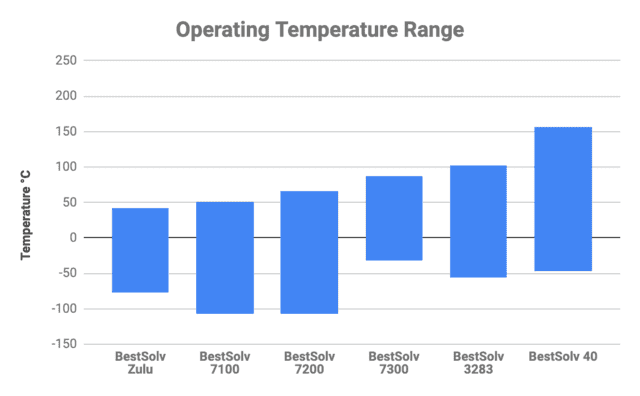
BestSolv Thermal Management Fluids - Operating Temperature Range

Material Compatibility for Thermal Management

BestSolv® Engineered Fluids are compatible with a wide range of materials used in thermal management systems. Their chemical stability, non-corrosive nature, and residue-free performance make them ideal for long-term use in high-performance cooling and electronic environments.

Polymers

Most “hard” plastics—including polycarbonate, polyethylene, and polypropylene—demonstrate excellent compatibility with BestSolv® HFE and PFC fluids. These materials retain structural integrity and dimensional stability even after extended exposure.

Elastomers

Elastomers that are lightly plasticized or non-plasticized perform well with BestSolv® fluids. Highly plasticized elastomers should be tested prior to use, as they may exhibit softening when exposed to low-viscosity HFE fluids.

Metals

Stainless steel, aluminum, copper, brass, and titanium are all compatible with BestSolv® fluids, making them suitable for use in heat exchangers, tanks, manifolds, and precision cooling systems.

Although BestSolv® fluids are chemically inert, slight variations in solvency exist between HFE-based and PFC-based formulations. HFE fluids (such as BestSolv® 7100, 7200, and 7300) have slightly higher solvency than PFCs and may affect soft elastomers or adhesives. For this reason, compatibility testing on non-production components is always recommended before full-scale implementation.

Immersion Cooling with BestSolv® Fluids

Immersion cooling is the process of submerging servers, electronic components, or entire systems in a non-conductive dielectric fluid that absorbs and dissipates heat directly from the hardware.

BestSolv® fluids—particularly Zulu, 7100, 7200, and 7300—are ideal for immersion cooling in data centers, power converters, and semiconductor environments. By replacing air cooling and heat sinks with direct-contact liquid cooling, operators can:

  • Reduce cooling energy consumption by up to 90–95%
  • Increase power density and processing capacity without thermal throttling
  • Lower data center footprint by reducing the need for large air-handling infrastructure

These fluids are non-flammable, residue-free, and VOC-exempt, making them a safe, efficient, and sustainable choice for continuous operation.

Electronics Reliability Testing with BestSolv® Fluids

Immersion is not only used for thermal management but also for testing and validation of sensitive electronic components. With their high dielectric strength, thermal stability, and chemical inertness, BestSolv® 3283 and BestSolv® 40 are excellent candidates for reliability testing, leak testing, and thermal shock testing in military and aerospace applications.

Electronic assemblies can be tested both physically and electrically while immersed, ensuring accurate results without risk of corrosion or residue. After testing, parts dry quickly with no post-cleaning required.

Common test applications include:

  • Gross Leak Testing – Non-destructive verification of hermetic seals using fluorinated liquids to detect bubble formation.
  • Thermal Shock Testing – Alternating exposure between hot and cold fluid baths to evaluate electronic component durability under extreme temperature cycling.

Both tests align with MIL-STD-883 and MIL-STD-202 protocols for aerospace and defense microelectronics, ensuring that components meet the reliability standards required for mission-critical systems.

Other Uses of BestSolv® Thermal Management Fluids

Semiconductor manufacturing – Consistent temperature control and heat transfer performance are critical in semiconductor fabrication. BestSolv® thermal management fluids deliver exceptional stability over long operating cycles, ensuring precise process control during wafer production, etching, and testing. Their wide operating ranges outperform aqueous coolants such as deionized (DI) water, minimizing risk of thermal fluctuations and corrosion.

Specialized chiller systems – Precise temperature control is critical in specialized machinery, electronics cooling, low-temperature process chillers, and other closed-loop thermal management systems. BestSolv® thermal management fluids, including BestSolv® 7100, can be used as dielectric, non-flammable, low-residue heat-transfer fluids where standard coolants such as water, glycol, or oil may not meet the system’s operating requirements. Their low viscosity, thermal stability, and compatibility with many common system materials make them a practical option for chiller applications that require reliable circulation, clean operation, and stable performance across repeated heating and cooling cycles.

Military and aerospace – Mission-critical electronics in defense and aviation systems demand cooling solutions that combine reliability, cleanliness, and safety. BestSolv® fluids meet these requirements with non-flammable, dielectric performance that ensures uptime and protects sensitive avionics. They are ideal for spray cooling, power electronics, and high-voltage systems, where conventional oils or glycol coolants are unsuitable.

Pharmaceutical and chemical processing – Thermal stability and worker safety are essential in secondary-loop and freeze-drying applications. BestSolv® fluids offer a clean, non-flammable, and non-reactive alternative to traditional solvents and oils, providing consistent temperature control and high safety margins for operators. Their chemical inertness and low toxicity make them a smart choice for controlled environments in pharmaceutical production and precision chemical processing.

For laboratories using HistoChill® and similar tissue-freezing bath systems, BestSolv® 7100 has been successfully revalidated by medical and laboratory customers as a replacement for 3M™ Novec™ 7000. With physical properties comparable to Novec™ 7000, BestSolv® 7100 offers a familiar transition path that can help minimize process disruption. Best Technology supports pathology, histology, and research laboratories with technical documentation, sample availability, and application guidance. Customers should complete their own internal evaluation and validation procedures for the intended use. Contact us to discuss your specific freezing bath configuration and validation requirements.

BestSolv® Medical Device Policy

BestSolv® thermal management fluids are not intended, nor approved, for direct incorporation into pharmaceuticals, cosmetics, or medical devices. These engineered fluids are designed strictly for use in industrial and manufacturing applications, such as cleaning, cooling, and thermal management processes.

Best Technology does not authorize or support the use of BestSolv® products as ingredients, components, or processing aids in finished medical or consumer products intended for direct human contact.

BestSolv® Thermal Management Fluid Data Sheets

For Best Technology’s Technical Data Sheets, please see the BestSolv® Engineered Fluids Technical Data Sheet (TDS) page.

Get Your BestSolv® Fluids Today

Trusted across aerospace, medical device, and electronics industries, BestSolv® Engineered Fluids offer a full range of high-performance fluids designed for reliability, safety, and system compatibility.

  • Validated in aerospace and medical manufacturing
  • Exceptional cooling performance across a wide operating temperature range
  • Backed by SDS, TDS, and expert application support from Best Technology

With proven performance and regulatory alignment, BestSolv® fluids are your long-term solution for heat transfer and thermal management.

📞 Call us today at (612) 392-2414, ext. 2 to find the right BestSolv® fluid for your application.
📩 Request a quote or technical consultation to see how BestSolv® can integrate into your process.

BestSolv® Price and Ordering

For purposes of product stewardship, BestSolv® Engineered Fluids cannot be sold directly online.

Please contact our chemical sales department for a quote by clicking the “Get a Quote” button, or call 612-392-2414, ext. 2.
Get a Quote

Latest News & Products from Best Technology

BestSolv Novec Replacements

Running Out of 3M™ Novec™ Stock? How to Transition to Your BestSolv® Replacement Path

Don’t let running out of 3M™ Novec™ stock become a concern. As 3M™ Novec™ Engineered Fluids moved toward discontinuation, manufacturers took different approaches to maintaining process continuity. Some transitioned to alternative fluids, while others secured additional inventory and continued operating with the chemistry already qualified in their process. If your operation is still using remaining Novec™ stock, [...]

Read More

Read More

Trusted By Thousands of Customers Since 1992

  • BestSolv® Engineered Fluids: 3M™ Novec™ Replacement
    • BestSolv® Engineered Fluids
    • Solvent Cleaning with BestSolv® Engineered Fluids
      • BestSolv® Alpha
      • BestSolv® Bravo
      • BestSolv® Delta
      • BestSolv® Echo
      • BestSolv® Lima
      • BestSolv® Omega: PFAS-Free
      • BestSolv® Omega Plus: PFAS-Free
      • BestSolv® Sierra
      • BestSolv® Theta
      • BestSolv® Zeta: PFAS-Free
      • BestSolv® 5408: Boeing Spec BAC 5408 Qualified Cleaning Solvent
      • BestSolv® 7100
      • BestSolv® 7200
      • BestSolv® 7300
      • BestSolv® 71DA
      • BestSolv® 71DE
      • BestSolv® 71IPA
      • BestSolv® 72DA
      • BestSolv® 72DE
      • BestSolv® 73DE
      • BestSolv® nPB: TCE Replacement
      • Latent Fingerprint Processing with BestSolv® Engineered Fluids
      • What Are Hydrofluoroether (HFE) Fluids?
      • Film Cleaning with BestSolv® 7200
      • Oxygen System and Oxygen Gauge Cleaning Solutions
      • Carrier Fluids for Precision Deposition, Wetting, and Material Transport
      • Choosing the Best Vapor Degreaser Solvent
    • Thermal Management / Heat Transfer with BestSolv® Engineered Fluids
      • BestSolv® Zulu Immersion Cooling Fluid
      • BestSolv® Zulu MAG Magnesium Protection Fluid
      • BestSolv® Zulu FS Fire Suppression Fluid
      • BestSolv® 7100
      • BestSolv® 7200
      • BestSolv® 7300
      • BestSolv® 3283
      • BestSolv® 40
      • BestSolv® Fluids as Coolants for Specialized Machinery and Chiller Systems
      • Magnesium Cover Gas, Re-Engineered for Today
      • Gross Leak Testing for Hermetic Components and Critical Assemblies
  • PFAS-Free Next Generation
    • BestSolv® Omega: PFAS Free
    • BestSolv® Omega Plus: PFAS-Free
    • BestSolv® Zeta: PFAS-Free
    • PFAS-Free Cleaning Solvents for Vapor Degreasing Applications
    • BestSolv® HFO / HCFO Solvents for Precision Cleaning
  • 3M™ Novec™ Replacements
    • 3M™ Novec™ Replacement Fluids
      • 3M™ Novec™ 7100 Replacements
      • 3M™ Novec™ 7200 Replacement
      • 3M™ Novec™ 7300 Replacement
      • 3M™ Novec™ 71DA Replacements
      • 3M™ Novec™ 71DE Replacement Options
      • 3M™ Novec™ 71IPA Replacements
      • 3M™ Novec™ 72DA Replacements
      • 3M™ Novec™ 72DE Replacements
      • 3M™ Novec™ 73DE Replacement
      • Running Out of 3M™ Novec™ Stock? How to Transition to Your BestSolv® Replacement Path
  • 3M™ Novec™ Engineered Fluids and Fluorinert™ Liquids
    • 3M™ Novec™ Engineered Fluids
      • 3M™ Novec™ HFE Engineered Fluids and PFAS Phase Out
    • Solvent Cleaning with 3M™ Novec™ Engineered Fluids
      • 3M™ Novec™ 7100
      • 3M™ Novec™ 7200
      • 3M™ Novec™ 7300
      • 3M™ Novec™ 71DA
      • 3M™ Novec™ 71DE
      • 3M™ Novec™ 71IPA
      • 3M™ Novec™ 72DA
      • 3M™ Novec™ 72DE
      • 3M™ Novec™ 73DE
    • 3M™ Fluorinert™ Electronic Liquids for Thermal Management / Heat Transfer
      • 3M™ Novec™ 649
      • 3M™ Novec™ 7100
      • 3M™ Novec™ 7200
      • 3M™ Novec™ 7300
  • Solvent Phase Outs
    • 3M™ Novec™ HFE Engineered Fluids and PFAS Phase Out
    • nPB Replacement
    • TCE Replacement
    • Methylene Chloride Replacement
  • Aqueous Cleaning
    • Aqueous Cleaning Solutions: Alkaline Cleaners
    • How Clean is Clean?
  • Surface Finishing Chemicals
    • CitriSurf Passivation Chemistry for Citric Acid Passivation
    • Electropolishing Solutions: Electrolyte Chemicals
    • Conversion Coating Chemistry
      • Hex Chrome Phase Out and Alternatives for Conversion Coating
    • Surface Finishing Chemicals: Passivation, Electropolishing & Conversion Coatings
  • Process Equipment
    • Vapor Degreaser Equipment and Ultrasonic Vapor Degreasers
    • Ultrasonic Cleaning Systems & Parts Cleaners
    • Passivation Equipment for Stainless Steel
    • Electropolishing Equipment
    • Chromate Conversion Coating Equipment for Aluminum
Best Technology Inc.

Best Technology Inc.
14040 23rd Avenue N.
Minneapolis, MN 55447

phone icon612.392.2414

Follow Us
  • Facebook icon
  • X icon
  • LinkedIn icon
  • YouTube icon
  • Pinterest icon

Quick Links

  • Product Line Card
  • Case Studies
  • Videos
  • Site Map
  • Equipment Financing
  • Contact Us

Products

  • Industrial Parts Washers
  • Ultrasonic Cleaning Systems
  • Passivation Equipment
  • Electropolishing Equipment
  • Surface Finishing Systems
  • Chemistries, Solvents & Fluids

Industries Served

  • Medical Device
  • Aerospace
  • Electronics
  • Automotive
Contact an Expert

Copyright © 2026 · Best Technology Inc. · Privacy Policy

Precision Cleaning, Passivation & Finishing Systems
Contact an Expert
612.392.2414
  • facebook
  • Twitter
  • LinkedIn
  • YouTube
  • Pinterest

"*" indicates required fields

1Your Info
2Request Pricing

Contact us for info and pricing on fluids!

Looking for a quote on fluids?

To provide a quote, we need additional details for product stewardship. The requested information helps ensure that the products are used in safe applications.
Quote Requested*
Click Yes if you would like to receive a quote on a fluid.

No pricing needed?

Click the Submit button to continue.

The section below is REQUIRED for a quote

Best Technology requires this information to be filled out for application records.
Please confirm*
Please confirm*
Please confirm*
Will the fluid be mixed into another formulation?*
Please describe your formulation IN DETAIL. Any reformulation using the fluid must be reviewed by Best Technology.
(Hold CTRL on keyboard for multiple selections)
BestSolv® fluids are currently approved for the following applications. Please select your application:*
Describe your application in detail. What materials will the chemical be used on, and will it be used inside a machine? Specify which fluid will be used (e.g., BestSolv® 7100).
Address where we will ship the fluid to. CANNOT be a residential address. Include full street address, city, state, zip.
Company where fluid will be used, if different from your company name
Address of End User, if different from Shipping Address. Include full street address, city, state, zip.
Anticipated volume of usage of this chemical over the next year