Best Technology

Precision Cleaning, Passivation & Finishing Systems

Call Us612.392.2414
Contact an Expert
  • Equipment
    • Industrial Parts Washers
    • Ultrasonic Cleaning Systems
    • Vapor Degreasing Systems
    • Passivation Equipment
    • Electropolishing Equipment
    • Chem Film Equipment
    • Titanium Anodizing Systems
    • Mass Finishing Machines
    • Automation Systems
    • Wet Benches
    • Specialty & Custom Industrial Process Systems
  • Chemicals
    • Chemicals, Solvents & Fluids
    • BestSolv® Engineered Fluids
    • 3M™ Novec™ Replacement Fluids
    • 3M™ Novec™ Engineered Fluids, Chemicals, & Solvents
    • 3M™ Novec™ HFE Engineered Fluids and PFAS Phase Out
  • Industries
  • Articles
    • FAQ – Frequently Asked Questions
    • Ultrasonic Cleaning
      • How Do Ultrasonic Cleaners Work?
    • Passivation
      • What is Passivation?
    • Electropolishing
      • What is Electropolishing?
    • Surface Finishing
      • What is Alodine® / Chem Film / Chromate Conversion Coating?
      • What is Titanium Anodizing?
    • Industrial Parts Washers
    • Automation Systems
  • Case Studies
    • Industry Applications
    • Industrial Parts Washer Case Studies
    • Passivation Systems Case Studies
    • Part Cleaning Case Studies
    • Part Finishing Equipment Case Studies
    • Ultrasonic Cleaning Systems Case Studies
  • Testimonials
  • About Us
  • Contact Us
  • Equipment
    • Industrial Parts Washers
      • Products
        • Agitated Immersion Heated Parts Washer
        • Automatic Parts Washer System with Conveyor
        • Phosphating Lines
        • Automated Phosphate Lines for High-Volume Powder Coat Pre-Treatment
        • Oil Removal Systems
      • Case Studies
        • Pipe Washing Equipment
        • Designing a Phosphate Line for Today’s Process and Tomorrow’s Needs
        • Machine Shop Parts Washer for True Oil
        • Automotive Parts Washer System
    • Ultrasonic Cleaning Systems
      • Product Information
        • How Clean is Clean?
        • How Do Ultrasonic Cleaners Work?
        • What is an Azeotrope?
      • Products
        • Benchtop Ultrasonic Cleaner
        • Benchtop Ultrasonic Parts Cleaning Multi-Tank Systems
        • Ultrasonic Cleaning Consoles
        • Automated Ultrasonic Parts Cleaning Equipment Wash-Rinse-Dry
        • Automated Ultrasonic Cleaning System for High-Volume Production
        • Large Ultrasonic Parts Cleaner with Agitated Immersion
        • Immersible Ultrasonic Transducers
      • Case Studies
        • Automated Pickling and Cleaning System Case Study
        • Automated Ultrasonic Injection Mold Cleaner System
        • 3D Printer / FDM Parts Post Process Ultrasonic Cleaning
        • Machine Shop Parts Washer for Swiss and CNC Precision Parts
    • Vapor Degreasing Systems
      • Product Information
        • What Is Vapor Degreasing?
      • Products
        • Vapor Degreasing Systems
        • Vapor Degreasing Equipment and Ultrasonic Vapor Degreasers
      • Case Studies
        • Vapor Degreaser For Medical Device Instruments
    • Passivation Equipment
      • Product Information
        • What is Passivation? How Does It Work?
        • Nitric vs. Citric Acid Passivation
        • Passivation with Citric Acid
        • What Is Pickling of Stainless Steel? How Do Descaling, Pickling and Etching Work?
        • Passivation Cost Savings Calculator
      • Products
        • Benchtop Ultrasonic Passivation Equipment
        • Passivation Wet Bench for Citric / Nitric Acid
        • Ultrasonic Automated Passivation Equipment
        • Automated Passivation Systems for High-Volume Production
        • Agitated Immersion Multi-Tank Passivation Systems
        • Salt Fog and Humidity Test Chambers for Reliable Corrosion and Environmental Testing
      • Case Studies
        • Case Study: Bringing Citric Acid Passivation In-House for Stainless Steel Medical Device Parts
        • Automated Ultrasonic Passivation System for Medical Device Parts
        • Cleanroom Space Saving Automated Passivation System
        • Heated Polypropylene Acid Passivation and Rinse Tanks
        • Applicable Articles
    • Electropolishing Equipment
      • Product Information
        • What is Electropolishing? How Does Electropolishing Work?
        • Electropolishing Cycle and Current Calculator
        • Passivation vs. Electropolishing
      • Products
        • Tabletop Electropolishing Equipment & Electropolishing Machines
        • Electropolishing Wet Benches
        • Semi-Automated Electropolishing Systems for High-Volume Production
        • Large Scale Part Electropolishing Systems
      • Case Studies
        • EP System – Open Top Wet Bench with Spray Rinse
    • Surface Finishing Systems
      • Chem Film Equipment / Alodine Lines
        • Chem Film Equipment
        • What is Alodine / Chem Film / Chromate Conversion Coating?
        • Alodine Chem Film Tank Line
        • Ready to Set Up a Chem Film (Alodine) Line?
        • Automated Chem Film (Alodine) Systems
        • Hex Chrome Phase Out and Alternatives for Conversion Coating
        • Salt Fog and Humidity Test Chambers for Reliable Corrosion and Environmental Testing
      • Mass Finishing Machines
        • Centrifugal Barrel Finishing Machines
        • Vibratory Bowl Polishers
      • Titanium Anodizing
        • Titanium Anodizing Systems
        • What is Titanium Anodizing?
        • Titanium Anodizing Equipment
    • Automation Systems
      • Product Information
        • What Is Process Automation for Metal Finishing?
      • Products
        • Rail-Mounted Gantry Crane Automation
        • Automated Passivation Systems for High-Volume Production
        • Automated Ultrasonic Cleaning System for High-Volume Production
        • Automated Chem Film (Alodine) Systems
        • Semi-Automated Electropolishing Systems for High-Volume Production
        • Automated Phosphate Lines for High-Volume Powder Coat Pre-Treatment
        • Ultrasonic Automated Passivation Equipment
      • Case Studies
        • Automated Pickling and Cleaning System Case Study
        • Automated Passivation for High-Volume Production: Case Study
    • Wet Benches
      • Product Information
        • What is a Fume Hood? How Do Fume Hoods Work?
      • Products
        • Fume Hoods
        • Wet Bench for Semiconductor & FM4910 Applications
        • Wet Benches for Citric / Nitric Passivation of Stainless Steel and Titanium
        • Wet Benches for Electropolishing
        • Cascade Overflow Rinse Tanks
        • Quick Dump Rinse Tank
      • Case Studies
        • Semiconductor Chemical Processing Wet Bench and Fume Hood
    • Specialty & Custom Industrial Process Systems
      • Automated Chemical Neutralization Tank Cart
      • Salt Fog and Humidity Test Chambers
      • Vapor and Dryfilm PTFE Coating Systems
      • Heated Hot Air Parts Dryer
      • Solvent Recovery Equipment
    • Process Validation Templates
    • Equipment Financing
  • Chemicals, Solvents & Fluids
    • Chemicals, Solvents & Fluids from Best Technology
    • BestSolv® Engineered Fluids
    • Solvent Cleaning Fluids
      • Solvent Cleaning with BestSolv® Engineered Fluids
      • BestSolv® Alpha
      • BestSolv® Bravo
      • BestSolv® Delta
      • BestSolv® Echo
      • BestSolv® Lima
      • BestSolv® Omega: PFAS Free
      • BestSolv® Omega Plus: PFAS-Free
      • BestSolv® Sierra
      • BestSolv® Theta
      • BestSolv® Zeta: PFAS-Free
      • BestSolv® 5408: Boeing Spec BAC 5408 Qualified Cleaning Solvent
      • BestSolv® 7100
      • BestSolv® 7200
      • BestSolv® 7300
      • BestSolv® 71DE
      • BestSolv® 72DA
      • BestSolv® 72DE
      • BestSolv® 73DE
      • BestSolv® nPB: TCE Replacement
      • Latent Fingerprint Processing with BestSolv® Engineered Fluids
      • What Are Hydrofluoroether (HFE) Fluids?
      • Film Cleaning with BestSolv® 7200
      • Oxygen System and Oxygen Gauge Cleaning Solutions
      • Engineered Fluids for Fluid Simulation and Aerospace Vibration Testing
      • Carrier Fluids for Precision Deposition, Wetting, and Material Transport
      • Choosing the Best Vapor Degreaser Solvent
    • Thermal Management / Heat Transfer Fluids
      • Thermal Management / Heat Transfer with BestSolv® Engineered Fluids
      • BestSolv® Zulu Immersion Cooling Fluid
      • BestSolv® Zulu MAG Magnesium Protection Fluid
      • BestSolv® Zulu FS Fire Suppression Fluid
      • BestSolv® 7100
      • BestSolv® 7200
      • BestSolv® 7300
      • BestSolv® 3283
      • BestSolv® 40
      • BestSolv® Fluids as Coolants for Specialized Machinery and Chiller Systems
      • Magnesium Cover Gas, Re-Engineered for Today
      • Gross Leak Testing for Hermetic Components and Critical Assemblies
    • PFAS-Free Next Generation
      • BestSolv® Omega: PFAS-Free
      • BestSolv® Omega Plus: PFAS-Free
      • BestSolv® Zeta: PFAS-Free
      • PFAS-Free Cleaning Solvents for Vapor Degreasing Applications
      • BestSolv® HFO / HCFO Solvents for Precision Cleaning
    • 3M™ Novec™ Replacements
      • 3M™ Novec™ Replacement Fluids
      • 3M™ Novec™ 7100 Replacements
      • 3M™ Novec™ 7200 Replacement
      • 3M™ Novec™ 7300 Replacement
      • 3M™ Novec™ 71DA Replacements
      • 3M™ Novec™ 71DE Replacement Options
      • 3M™ Novec™ 71IPA Replacements
      • 3M™ Novec™ 72DA Replacements
      • 3M™ Novec™ 72DE Replacements
      • 3M™ Novec™ 73DE Replacement
      • Running Out of 3M™ Novec™ Stock? How to Transition to Your BestSolv® Replacement Path
    • 3M™ Novec™ Engineered Fluids and Fluorinert™ Liquids
      • 3M™ Novec™ Engineered Fluids
      • 3M™ Novec™ HFE Engineered Fluids and PFAS Phase Out
      • 3M™ Novec™ Cleaning Solvents
        • Solvent Cleaning with 3M™ Novec™ Engineered Fluids
        • 3M™ Novec™ 7100
        • 3M™ Novec™ 7200
        • 3M™ Novec™ 7300
        • 3M™ Novec™ 71DA
        • 3M™ Novec™ 71DE
        • 3M™ Novec™ 71IPA
        • 3M™ Novec™ 72DA
        • 3M™ Novec™ 72DE
        • 3M™ Novec™ 73DE
      • 3M™ Fluorinert™ and 3M™ Novec™ Heat Transfer and Thermal Management Fluids
        • 3M™ Fluorinert™ Electronic Liquids for Thermal Management / Heat Transfer
        • 3M™ Novec™ 649
        • 3M™ Novec™ 7100
        • 3M™ Novec™ 7200
        • 3M™ Novec™ 7300
    • Solvent Phase Outs
      • 3M™ Novec™ HFE Engineered Fluids and PFAS Phase Out
      • nPB Replacement
      • TCE Replacement
      • Methylene Chloride Replacement
    • Aqueous Cleaning
      • Aqueous Cleaning Solutions: Alkaline Cleaners
      • How Clean is Clean?
    • Surface Finishing Chemicals
      • CitriSurf Passivation Chemistry for Citric Acid Passivation
      • Electropolishing Solutions: Electrolyte Chemicals
      • Conversion Coating Chemistry
      • Hex Chrome Phase Out and Alternatives for Conversion Coating
  • Industries
  • Customer Testimonials
  • About Us
  • Contact Us
Contact an Expert
home Best Technology / BestSolv® Engineered Fluids / Gross Leak Testing for Hermetic Components and Critical Assemblies

Gross Leak Testing for Hermetic Components and Critical Assemblies

Table of contents
  1. What Is Gross Leak Testing?
  2. How Gross Leak Testing Works
    1. Bubble Testing Method
    2. Why Fluorocarbon and Hydrofluoroether Liquids Are Used
  3. Applications Beyond Electronics
    1. Typical Test Setup
  4. MIL-STD-202 and MIL-STD-883 Requirements
    1. MIL-STD-202 Overview
    2. MIL-STD-883 Overview
    3. Why Standards Matter
  5. Fluids for Gross Leak Testing
  6. Why Use BestSolv® Fluids
    1. BestSolv® 40
    2. BestSolv® 7100
    3. BestSolv® Sierra
  7. Typical Applications and Use Cases
  8. Related Testing Applications
  9. Related Products
  10. Need Help Selecting the Right Fluid?
  11. BestSolv® Price and Ordering

Gross leak testing is a critical step in verifying the integrity of sealed components and assemblies used in high-reliability applications. In aerospace, defense, medical device, automotive, electronics, and other precision manufacturing environments, even a small seal failure can lead to moisture ingress, fluid intrusion, corrosion, contamination, pressure loss, or premature system failure.

Using fluorocarbon or hydrofluoroether (HFE) liquids, gross leak testing provides a fast, non-destructive method to identify leaks through visible bubble formation. This method is widely used in accordance with MIL-STD-202 and MIL-STD-883 to ensure components meet strict reliability requirements.

While gross leak testing is commonly associated with hermetic electronic components, the application is broader than electronics alone. Manufacturers may use gross leak testing to evaluate sealed medical device components, automotive assemblies, sensors, housings, connectors, and other parts where leakage could affect performance, safety, cleanliness, or long-term reliability.

Fluids such as BestSolv® 40, BestSolv® 7100, and BestSolv® Sierra are well suited for these applications due to their chemical inertness, dielectric strength, and stability under test conditions.

What Is Gross Leak Testing?
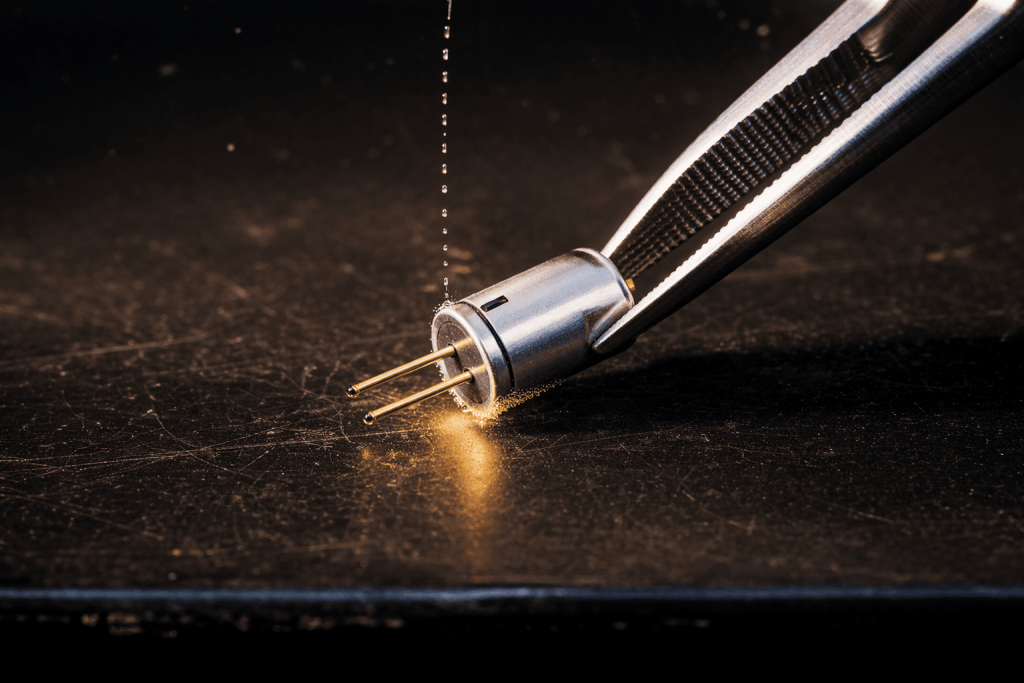
Gross Leak Testing - Hermetic Electronics - Fluorocarbon Fluids

Gross leak testing is a non-destructive method used to detect large leaks in hermetically sealed components. Unlike fine leak testing, which measures very small leak rates, gross leak testing focuses on identifying defects that allow rapid ingress of air or moisture.

The method is typically qualitative, providing a clear pass or fail result based on whether a leak is present. This makes it an effective first step in validating seal integrity before or alongside more sensitive testing methods.

In high-reliability environments, gross leak testing helps confirm that components meet baseline sealing requirements before being deployed in critical systems. Depending on the application, this may include hermetically sealed electronics, medical device components, automotive assemblies, sensors, connectors, or other sealed parts that must resist moisture, fluid, air, or contaminant intrusion.


How Gross Leak Testing Works

Gross Leak Testing - Gross Leak application - Hermetic Electronics - Fluorocarbon Fluids

Bubble Testing Method

The most common gross leak testing approach is bubble testing.

Components are first pressurized and then immersed in an inert liquid. If a leak is present, gas escapes from the component and forms visible bubbles in the fluid.

This visual confirmation makes the method simple, fast, and highly effective for identifying seal failures.

Why Fluorocarbon and Hydrofluoroether Liquids Are Used

Fluorocarbon liquids and hydrofluoroether liquids offer unique properties that are essential to this process:

  • Low surface tension allows penetration into small defects
  • Chemical inertness prevents reaction with sensitive components
  • High dielectric strength enables safe testing of electronics
  • Clean evaporation leaves no residue after testing

These properties ensure accurate results without damaging the component or requiring additional cleaning steps.

Applications Beyond Electronics

Although gross leak testing is often discussed in the context of hermetic electronics, many manufacturers use the process for other sealed components and assemblies.

In medical device manufacturing, gross leak testing may be used where seal integrity affects cleanliness, sterility, fluid containment, or long-term product performance. In automotive manufacturing, it may support testing of sealed components, sensors, housings, connectors, or assemblies exposed to fluids, pressure changes, vibration, and environmental conditions.

For many customers, the application is simply described as “gross leak testing.” The specific industry may vary, but the core requirement is the same: identifying leaks before they create reliability, safety, or performance problems in the field.

Typical Test Setup

Gross leak testing is commonly performed using immersion-based systems, including automated bubble test equipment.

In many cases, heated baths are used to enhance detection sensitivity by encouraging trapped gases to expand and escape through leak paths. Systems such as standard gross leak detectors used in aerospace and electronics manufacturing are designed specifically for this purpose.

MIL-STD-202 and MIL-STD-883 Requirements

MIL-STD-202 - MIL-STD-883

MIL-STD-202 Overview

MIL-STD-202, “Test Method Standard, Electronic and Electrical Component Parts,” defines test methods used to evaluate electronic component reliability under various environmental conditions.

Within this standard, gross leak testing is used to verify hermetic sealing performance. Specific methods and conditions, such as Method 112 and defined test conditions (including Condition D and E), outline how fluorocarbon liquids are used in bubble testing procedures.

These methods are widely referenced in procurement and qualification requirements across aerospace and defense applications.

MIL-STD-883 Overview

MIL-STD-883, “Test Method Standard, Microcircuits,” focuses on microelectronics and establishes test methods for ensuring long-term reliability of hermetically sealed devices.

Gross leak testing plays a role in verifying package integrity before or alongside fine leak testing methods. It ensures that large seal defects are identified early in the validation process.

Why Standards Matter

Compliance with these standards ensures:

  • Consistent and repeatable test results
  • Qualification for aerospace and defense applications
  • Confidence in long-term component performance

For many manufacturers, adherence to these standards is not optional. It is a requirement for doing business in regulated industries.

Fluids for Gross Leak Testing

Fluorocarbon liquids and hydrofluoroether liquids have long been used in gross leak testing due to their stability and predictable performance under test conditions.

Historically, fluids such as 3M™ Fluorinert FC-40 and 3M™ Novec™ 7100 were commonly specified in test procedures. With 3M™ Novec™ and 3M™ Fluorinert™ phased out and evolving regulations, equivalent engineered fluids are now required to maintain continuity in testing processes.

These fluids enable:

  • Reliable bubble formation for leak detection
  • Stable performance across a wide temperature range
  • Compatibility with sensitive electronic materials

Why Use BestSolv® Fluids
BestSolv® fluids - BestSolv 40 - BestSolv 7100 - Gross Leak testing fluids

BestSolv® 40

BestSolv® 40 is a high-performance fluorocarbon fluid designed as a replacement for 3M™ Fluorinert FC-40. It is well suited for gross leak testing applications requiring:

  • High dielectric strength
  • Wide operating temperature range
  • Stability under MIL-STD testing conditions

Its performance characteristics make it a strong fit for aerospace and defense testing environments.

BestSolv® 7100

BestSolv® 7100 is a high-performance hydrofluoroether (HFE) fluid designed as an exact-molecule replacement for 3M™ Novec™ 7100. It is well suited for gross leak testing applications requiring:

  • Identical performance to 3M™ Novec™ 7100
  • Match for processes validated for 3M™ Novec™ 7100
  • Wide operating temperature range
  • Low Global Warming Potential (GWP)

BestSolv® Sierra

BestSolv® Sierra is a high-performance hydrofluoroether (HFE) fluid designed as a similar-molecule replacement for 3M™ Novec™ 7100. It is well suited for gross leak testing applications requiring:

  • Functionally equivalent performance to 3M™ Novec™ 7100
  • Lower-cost alternative fluid
  • Low Global Warming Potential (GWP)

Operational Advantages

Using BestSolv® fluids in gross leak testing provides:

  • No post-cleaning required
  • Fast drying after immersion
  • Reusability through distillation
  • Compatibility with automated testing systems

These advantages help improve efficiency while maintaining test accuracy.

Typical Applications and Use Cases

Gross leak testing is used across industries where hermetic sealing is critical:

  • Aerospace electronics and avionics systems
  • Defense components and sealed connectors
  • Microelectronics and semiconductor devices
  • Medical device components and assemblies
  • Automotive sensors, housings, and sealed parts
  • High-reliability industrial assemblies
  • Precision components exposed to moisture, fluids, pressure changes, or contamination risk

In these applications, leak detection is directly tied to product performance, safety, and long-term reliability.

Related Testing Applications

Gross leak testing is often used alongside other reliability testing methods, including:

  • Thermal Shock Testing
  • Electronics Reliability Testing

These methods work together to validate performance under real-world operating conditions.

Related Products

  • BestSolv® 40
  • BestSolv® 7100
  • BestSolv® Sierra

Need Help Selecting the Right Fluid?

If you are working to meet MIL-STD-202 or MIL-STD-883 requirements, selecting the right test fluid is critical to achieving accurate and repeatable results.

Contact our team to discuss your application, testing method, and fluid requirements. We can help you identify the best solution for your process.

BestSolv® Price and Ordering

For purposes of product stewardship, BestSolv® Engineered Fluids cannot be sold directly online.

Please contact our chemical sales department for a quote by clicking the “Get a Quote” button, or call 612-392-2414, ext. 2.
Get a Quote

Latest News & Products from Best Technology

Industrial vapor-only degreasing machine

Vapor Degreasing Equipment and Ultrasonic Vapor Degreasers

Industrial Precision Cleaning Solutions Best Technology supplies industrial vapor degreasing equipment for manufacturers requiring reliable, repeatable precision cleaning. Our vapor degreasers are configured around each customer's application, including part dimensions, contaminants, cleaning requirements, solvent selection, and production throughput. [joli-toc] We offer equipment solutions ranging from [...]

Read More

Read More

Trusted By Thousands of Customers Since 1992

  • BestSolv® Engineered Fluids: 3M™ Novec™ Replacement
    • BestSolv® Engineered Fluids
    • Solvent Cleaning with BestSolv® Engineered Fluids
      • BestSolv® Alpha
      • BestSolv® Bravo
      • BestSolv® Delta
      • BestSolv® Echo
      • BestSolv® Lima
      • BestSolv® Omega: PFAS-Free
      • BestSolv® Omega Plus: PFAS-Free
      • BestSolv® Sierra
      • BestSolv® Theta
      • BestSolv® Zeta: PFAS-Free
      • BestSolv® 5408: Boeing Spec BAC 5408 Qualified Cleaning Solvent
      • BestSolv® 7100
      • BestSolv® 7200
      • BestSolv® 7300
      • BestSolv® 71DA
      • BestSolv® 71DE
      • BestSolv® 71IPA
      • BestSolv® 72DA
      • BestSolv® 72DE
      • BestSolv® 73DE
      • BestSolv® nPB: TCE Replacement
      • Latent Fingerprint Processing with BestSolv® Engineered Fluids
      • What Are Hydrofluoroether (HFE) Fluids?
      • Film Cleaning with BestSolv® 7200
      • Oxygen System and Oxygen Gauge Cleaning Solutions
      • Engineered Fluids for Fluid Simulation and Aerospace Vibration Testing
      • Carrier Fluids for Precision Deposition, Wetting, and Material Transport
      • Choosing the Best Vapor Degreaser Solvent
    • Thermal Management / Heat Transfer with BestSolv® Engineered Fluids
      • BestSolv® Zulu Immersion Cooling Fluid
      • BestSolv® Zulu MAG Magnesium Protection Fluid
      • BestSolv® Zulu FS Fire Suppression Fluid
      • BestSolv® 7100
      • BestSolv® 7200
      • BestSolv® 7300
      • BestSolv® 3283
      • BestSolv® 40
      • BestSolv® Fluids as Coolants for Specialized Machinery and Chiller Systems
      • Magnesium Cover Gas, Re-Engineered for Today
      • Gross Leak Testing for Hermetic Components and Critical Assemblies
  • PFAS-Free Next Generation
    • BestSolv® Omega: PFAS Free
    • BestSolv® Omega Plus: PFAS-Free
    • BestSolv® Zeta: PFAS-Free
    • PFAS-Free Cleaning Solvents for Vapor Degreasing Applications
    • BestSolv® HFO / HCFO Solvents for Precision Cleaning
  • 3M™ Novec™ Replacements
    • 3M™ Novec™ Replacement Fluids
      • 3M™ Novec™ 7100 Replacements
      • 3M™ Novec™ 7200 Replacement
      • 3M™ Novec™ 7300 Replacement
      • 3M™ Novec™ 71DA Replacements
      • 3M™ Novec™ 71DE Replacement Options
      • 3M™ Novec™ 71IPA Replacements
      • 3M™ Novec™ 72DA Replacements
      • 3M™ Novec™ 72DE Replacements
      • 3M™ Novec™ 73DE Replacement
      • Running Out of 3M™ Novec™ Stock? How to Transition to Your BestSolv® Replacement Path
  • 3M™ Novec™ Engineered Fluids and Fluorinert™ Liquids
    • 3M™ Novec™ Engineered Fluids
      • 3M™ Novec™ HFE Engineered Fluids and PFAS Phase Out
    • Solvent Cleaning with 3M™ Novec™ Engineered Fluids
      • 3M™ Novec™ 7100
      • 3M™ Novec™ 7200
      • 3M™ Novec™ 7300
      • 3M™ Novec™ 71DA
      • 3M™ Novec™ 71DE
      • 3M™ Novec™ 71IPA
      • 3M™ Novec™ 72DA
      • 3M™ Novec™ 72DE
      • 3M™ Novec™ 73DE
    • 3M™ Fluorinert™ Electronic Liquids for Thermal Management / Heat Transfer
      • 3M™ Novec™ 649
      • 3M™ Novec™ 7100
      • 3M™ Novec™ 7200
      • 3M™ Novec™ 7300
  • Solvent Phase Outs
    • 3M™ Novec™ HFE Engineered Fluids and PFAS Phase Out
    • nPB Replacement
    • TCE Replacement
    • Methylene Chloride Replacement
  • Aqueous Cleaning
    • Aqueous Cleaning Solutions: Alkaline Cleaners
    • How Clean is Clean?
  • Surface Finishing Chemicals
    • CitriSurf Passivation Chemistry for Citric Acid Passivation
    • Electropolishing Solutions: Electrolyte Chemicals
    • Conversion Coating Chemistry
      • Hex Chrome Phase Out and Alternatives for Conversion Coating
    • Surface Finishing Chemicals: Passivation, Electropolishing & Conversion Coatings
  • Process Equipment
    • What Is Vapor Degreasing? How the Process Works and Its Industrial Applications
    • Ultrasonic Cleaning Systems & Parts Cleaners
    • Passivation Equipment for Stainless Steel
    • Electropolishing Equipment
    • Chromate Conversion Coating Equipment for Aluminum
Best Technology Inc.

Best Technology Inc.
14040 23rd Avenue N.
Minneapolis, MN 55447

phone icon612.392.2414

Follow Us
  • Facebook icon
  • X icon
  • LinkedIn icon
  • YouTube icon
  • Pinterest icon

Quick Links

  • Product Line Card
  • Case Studies
  • Videos
  • Site Map
  • Equipment Financing
  • Contact Us

Products

  • Industrial Parts Washers
  • Ultrasonic Cleaning Systems
  • Passivation Equipment
  • Electropolishing Equipment
  • Surface Finishing Systems
  • Chemistries, Solvents & Fluids

Industries Served

  • Medical Device
  • Aerospace
  • Electronics
  • Automotive
Contact an Expert

Copyright © 2026 · Best Technology Inc. · Privacy Policy

Precision Cleaning, Passivation & Finishing Systems
Contact an Expert
612.392.2414
  • facebook
  • Twitter
  • LinkedIn
  • YouTube
  • Pinterest

"*" indicates required fields

1Your Info
2Request Pricing

Contact us for info and pricing on fluids!

Looking for a quote on fluids?

To provide a quote, we need additional details for product stewardship. The requested information helps ensure that the products are used in safe applications.
Quote Requested*
Click Yes if you would like to receive a quote on a fluid.

No pricing needed?

Click the Submit button to continue.

The section below is REQUIRED for a quote

Best Technology requires this information to be filled out for application records.
Please confirm*
Please confirm*
Please confirm*
Will the fluid be mixed into another formulation?*
Please describe your formulation IN DETAIL. Any reformulation using the fluid must be reviewed by Best Technology.
(Hold CTRL on keyboard for multiple selections)
BestSolv® fluids are currently approved for the following applications. Please select your application:*
Describe your application in detail. What materials will the chemical be used on, and will it be used inside a machine? Specify which fluid will be used (e.g., BestSolv® 7100).
Address where we will ship the fluid to. CANNOT be a residential address. Include full street address, city, state, zip.
Company where fluid will be used, if different from your company name
Address of End User, if different from Shipping Address. Include full street address, city, state, zip.
Anticipated volume of usage of this chemical over the next year